

Two Years Behind a Fence: Who Is Responsible for Tigné’s Rotting Walkway?
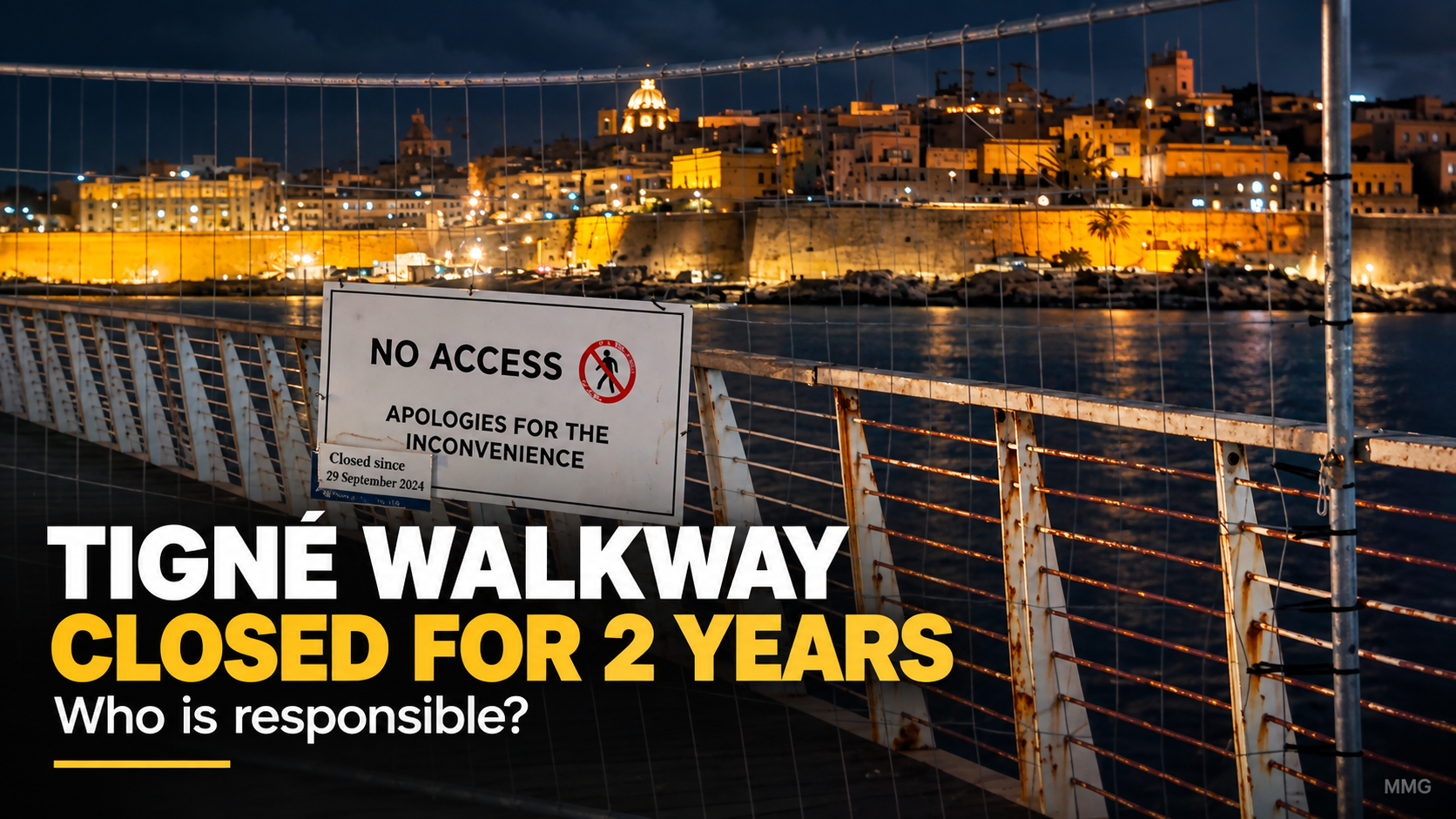
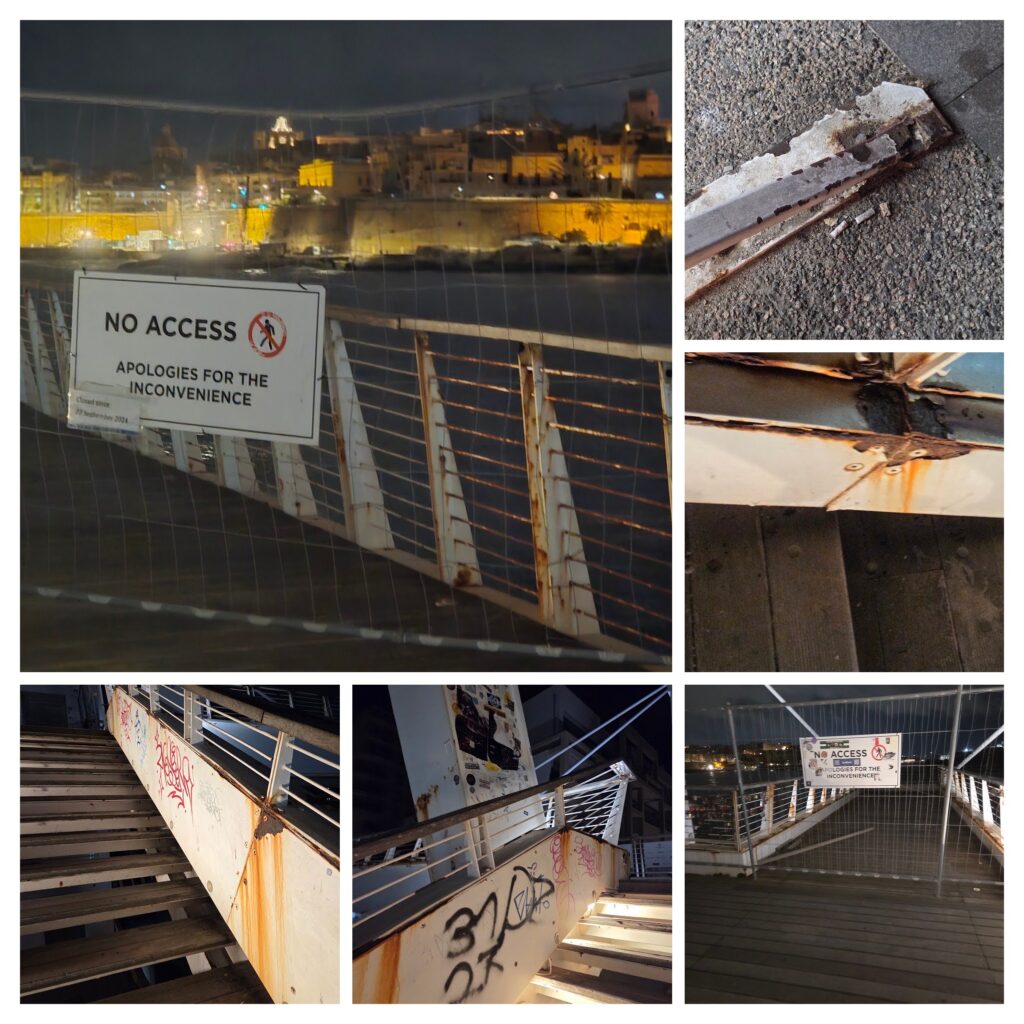
Nearly two years after the Tigné Point walkway was closed to the public, the fencing is still there, the bridge is still inaccessible and the photographs now tell their own story: rust, corrosion and deterioration.
The Belvedere walkway and suspended pedestrian route at Tigné Point were closed on 27 September 2024. At the time, MIDI described the closure as precautionary and said there had been no incident which triggered it.
Fast-forward to September 2026 and the public is still being greeted by a sign saying:
“NO ACCESS – Apologies for the inconvenience.”
What started as a precautionary closure has turned into an almost two-year shutdown of an important section of Sliema’s waterfront pedestrian route.
The deterioration did not appear overnight
Concerns about the structure go back considerably further than the closure.
In 2022, photographs showing exposed steel reinforcement beneath the bridge were already being circulated publicly. At the time, MIDI and the then Sliema mayor said there was no cause for concern.
MIDI also said it had commissioned a structural engineer to determine what maintenance was necessary and that works were expected to start the following year.
Two years later, however, the walkway was closed.
MIDI subsequently described the suspended walkway as being in a “very severe state of disrepair” and posing a health and safety risk in a public place.
So who is supposed to maintain it?
This is where things become particularly interesting.
MIDI says responsibility for maintaining the relevant public areas passed to the Government once those areas were completed.
And there is documentary support for that position.
MIDI’s own 2008 prospectus, summarising the 2000 emphyteutical deed with the Government, states that once Public Infrastructure and Public Areas are completed, their “responsibility and control” pass to the Government, even before their formal transfer through a public deed.
It further states that the Government – or an authority designated by it – then becomes responsible for:
- maintenance;
- upkeep;
- repair;
- replacement; and
- cleanliness.
Article 12 of the original concession deed contains substantially the same provision.
Yet reports indicate that when MIDI presented the Lands Authority with repair proposals, reportedly costing around €900,000, the Authority declined to fund them on the basis that the area had not been legally transferred back to Government ownership.
There may be contractual or technical details which affect how that clause applies to this particular structure. If so, those details should be explained publicly.
What is not reasonable is for a major public pedestrian route to remain fenced off indefinitely while two parties argue over whose invoice it is.
Residents say warnings were ignored
The Tigné Point South Residents Association has previously argued that the steel structure required regular protection from corrosion because of its exposed seaside location.
Its chairman, Joe Muscat, told the Times of Malta that residents had repeatedly called for the steel to be maintained and painted.
Environmental NGO Flimkien għal Ambjent Aħjar has also criticised what it described as a lack of maintenance which allowed the structure to deteriorate to the point that it had to be closed.
The photographs taken this week show widespread visible corrosion on railings, connections and other metal elements. They do not, by themselves, establish the structural condition of the bridge – that requires an engineer – but they certainly demonstrate why questions about its maintenance are legitimate.
Meanwhile, Government and MIDI managed to settle a much bigger deal
There is another reason why the continuing stalemate is difficult to understand.
In May 2026, MIDI and the Government concluded an agreement terminating the company’s concession over Manoel Island and Fort Tigné. The agreement involved a reported Government reimbursement of €47.3 million, including reimbursable VAT.
The remainder of the Tigné Point concession was specifically left in force.
In other words, Government and MIDI were capable of negotiating and concluding a major agreement involving tens of millions of euros and the future of two major sites.
Yet, almost two years after this walkway was fenced off, the public still does not appear to have a clear repair timetable.
MGW has some very simple questions
For MIDI: What maintenance was carried out after the deterioration was identified in 2022, and what is the present estimated cost of restoring the walkway?
For the Lands Authority: Does it accept that Article 12 places responsibility for maintenance of completed Public Areas on Government? If not, why not?
For both parties: Who currently has responsibility for this particular bridge and walkway?
And most importantly: When will repairs actually start, and when will the public get its walkway back?
Enough of the permanent “temporary” fence
This is not an obscure structure hidden away from the public. It forms part of one of Malta’s most prominent waterfront developments and was promoted as part of an uninterrupted pedestrian route around Tigné Point.
People should not need to understand a 99-year emphyteutical concession, determine which development phase a bridge belongs to, or decide the difference between legal ownership and contractual responsibility simply to find out why a public walkway has been closed for almost two years.
MIDI and the Government need to establish responsibility, explain it clearly and get the structure repaired.
Because after almost two years, “Apologies for the inconvenience” is starting to look considerably less like a temporary notice and considerably more like the maintenance plan.
Malta Gone Wild has contacted/recommends seeking clarification from MIDI plc and the Lands Authority and will update this article with any response received.