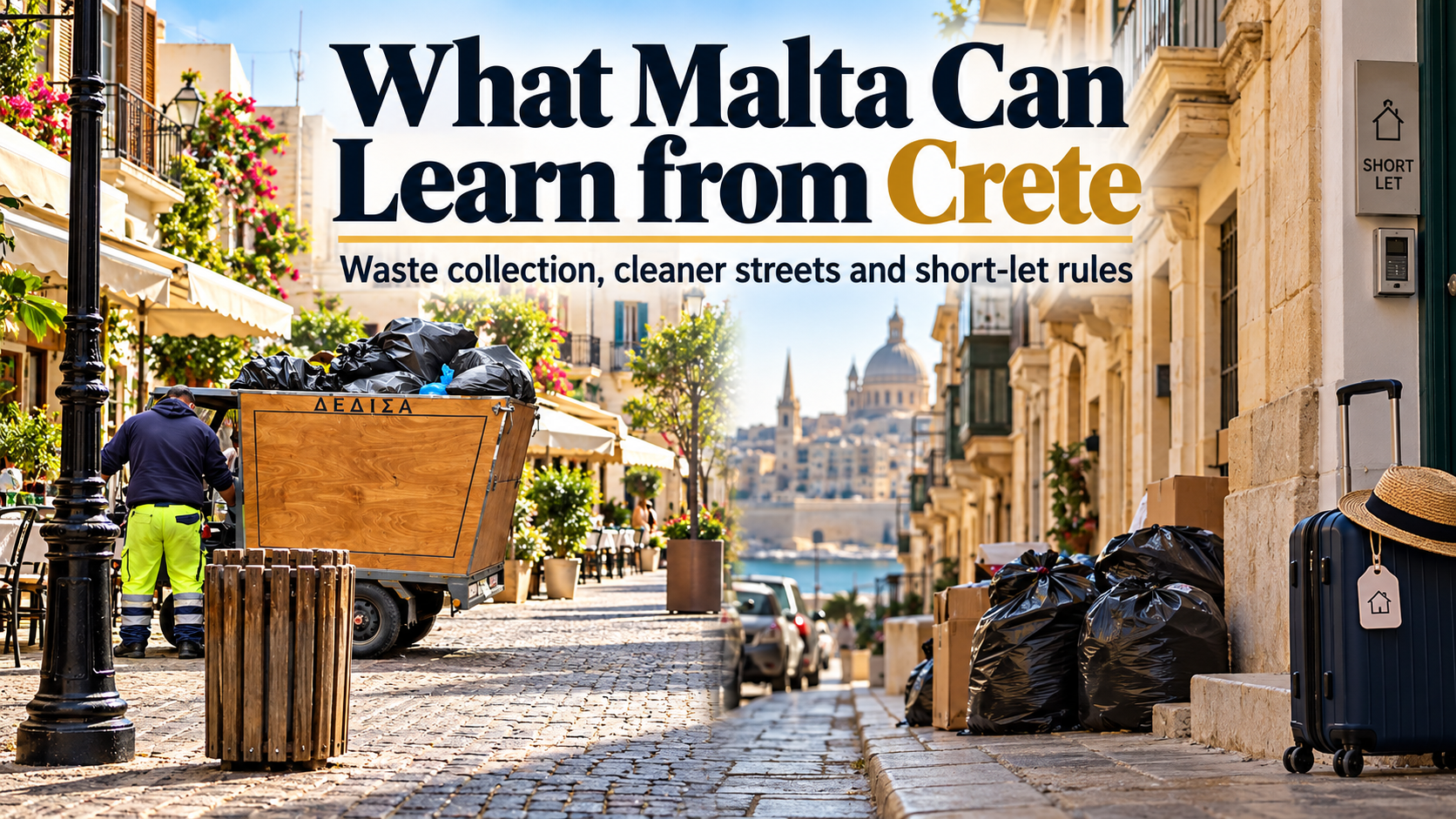

Walking through the historic streets of Chania in Crete, one thing immediately stood out: just how clean everything was. Despite the cafés, restaurants, tourists and holiday accommodation, the Old Town was remarkably well maintained. And the same impression continued across the other parts of Crete we visited.
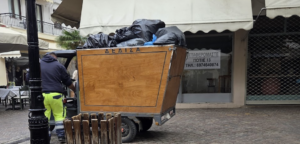
One particularly interesting sight was the way rubbish was collected. Rather than relying solely on large garbage trucks, a municipal worker was using a compact collection vehicle capable of navigating narrow historic streets. It might appear to be a small detail, but it raises an important question: if Chania can keep its historic centre clean while welcoming large numbers of visitors, what could Malta learn from its approach?
How Chania Keeps Its Historic Streets Clean
Chania has a municipal waste management company called DEDISA, which operates waste collection and recycling services. According to the organisation, a dedicated source-separation and door-to-door collection programme began in parts of Chania’s historic centre in 2012 and subsequently expanded across the Old Town.
The collection fleet includes smaller refuse vehicles and compact electric trucks capable of accessing streets where conventional garbage trucks might struggle. This is particularly useful in a historic Mediterranean city with narrow roads, pedestrian areas and busy hospitality establishments.
Chania also has municipal cleanliness regulations covering the responsibilities of residents and businesses regarding waste storage and disposal. The combination of suitable equipment, organised collections and rules for handling waste offers a practical model worth examining.
The lesson for Malta: Waste collection should be adapted to the needs of individual streets. A narrow street in Valletta or Sliema should not necessarily be serviced in exactly the same way as a wide residential road elsewhere.
How Does Malta Compare?
Malta already has a national household waste collection schedule, with separate collection days for organic, mixed and recyclable waste. However, the demands of a quiet residential neighbourhood are very different from those of a street packed with restaurants, tourist apartments, hotels and shops.
In heavily populated areas such as Sliema, Gżira, St Julian’s and Valletta, rubbish bags can occupy pavements while awaiting collection. When rubbish is deposited incorrectly or left outside for extended periods, the problem becomes even more noticeable. This can create unpleasant conditions and obstruct pedestrian access, especially in streets where pavements are already narrow.
According to the National Statistics Office, Malta generated 353,525 tonnes of municipal waste in 2024, an increase of 6.1% compared with 2023. The NSO also reported that 79.2% of treated municipal waste was landfilled during 2024. These figures illustrate the wider pressure on waste management, although they do not directly measure the cleanliness of individual streets.
| Area | Chania’s Approach | What Malta Could Do |
|---|---|---|
| Historic streets | Compact refuse vehicles suitable for narrow roads. | Introduce smaller collection vehicles in congested areas. |
| Waste collection | Dedicated Old Town door-to-door arrangements. | Adapt collection schedules to the needs of individual streets. |
| Businesses | Municipal rules covering waste storage and disposal. | Strengthen commercial collection arrangements and enforcement. |
| Tourist accommodation | Municipal cleanliness obligations alongside national accommodation rules. | Verify short-let waste management plans and operator responsibilities. |
| Public spaces | Smaller vehicles can access difficult locations. | Reduce the time rubbish occupies pavements. |
Short-Lets: A Growing Responsibility
There is another important factor Malta cannot ignore: the pressure tourist accommodation can place on residential neighbourhoods. Consider an ordinary apartment block containing both permanent residents and short-term holiday rentals. Tourists may check out on a Sunday, while their next rubbish collection day is several days away. Some visitors may not understand Malta’s waste separation requirements, while others simply follow the instructions provided by their hosts.
But who takes responsibility when rubbish is left outside on the wrong day? And should neighbouring residents be expected to deal with the consequences of poorly managed holiday accommodation?
Operating a short-let is a commercial tourism activity, and with that comes responsibility for managing the waste generated by guests.
Malta’s New Short-Let Regulations in 2026
Malta introduced additional accommodation obligations through the Tourism Accommodation Regulations, 2026 (S.L. 409.24), which came into force on 15 June 2026. The Malta Tourism Authority has published guidance on the obligations applying to short-let operators.
These requirements include:
- Waste management plans: Operators must submit a waste management plan with new licence applications or when renewing existing licences.
- 24-hour contact person: A designated person must be contactable to handle complaints relating to the accommodation.
- Property identification: Requirements apply to displaying accommodation licence and contact information, subject to relevant implementation arrangements.
- Condominium notification: New licensees operating in apartment buildings must notify the condominium administrator.
- Enforcement: Breaches of applicable licensing requirements can result in regulatory action and penalties.
These are existing regulatory obligations, not proposals being introduced by Malta Gone Wild. However, existing operators may submit their waste management plans when renewing their licences, meaning implementation should be examined carefully.
What Should a Short-Let Waste Management Plan Cover?
For such a plan to be effective, it should clearly explain where rubbish is stored, how guests are informed about recycling, who handles waste after checkout, what happens when guests depart on a non-collection day, and who neighbours can contact when problems arise.
A waste management plan should mean practical responsibility, not simply another document filed with the authorities. These operational details are recommendations for effective implementation, rather than a claim that each is separately prescribed by law.
What About Short-Let Rules in Greece?
Greece operates a national short-term accommodation registration system through its tax authority, AADE. Operators generally need to register eligible properties and declare short-term stays. Additional national accommodation standards introduced under Law 5170/2025 took effect on 1 October 2025, covering matters such as fire safety, liability insurance and property safety.
These national accommodation rules should not be confused with Chania’s municipal cleanliness regulations. The important distinction is that a city can combine its own collection methods and public cleanliness requirements with national rules governing tourist accommodation.
Six Practical Changes Malta Could Introduce
1. Smaller waste collection vehicles. Malta could introduce compact, preferably electric, vehicles to operate in narrow streets and pedestrian areas. Valletta, Sliema, Gżira and St Julian’s would be suitable locations to assess for pilot programmes.
2. Clear short-let waste responsibilities. Operators should be responsible for ensuring that waste generated by guests is properly stored and disposed of. Checking out on a non-collection day should not result in rubbish being left outside for several days.
3. Less rubbish on pavements. Secure indoor storage should be encouraged where practical. Where this is impossible, carefully planned communal collection facilities could be considered, provided they do not obstruct pavements or create additional problems for residents.
4. Collection services adapted to commercial activity. Streets with large numbers of restaurants, hotels and professionally managed holiday apartments may require different collection arrangements from those serving mainly residential properties.
5. Consistent enforcement. Regulations are only useful when people follow them. Reports of repeated illegal dumping, incorrect waste disposal or poor short-let management should be investigated, with proportionate enforcement against persistent offenders.
6. Transparency and accountability. Authorities could publish information about cleanliness complaints, missed collections, response times and enforcement actions. This would help residents understand whether local conditions are improving.
Should Tourism Help Finance Cleaner Streets?
Malta already collects an environmental contribution from applicable tourist accommodation stays. Since 1 July 2026, this has been €1.50 per adult per night, capped at €22.50 per person per visit.
It would be worth considering whether a clearly identified portion of tourism-related revenue could support additional waste collection and street cleaning in localities experiencing substantial visitor pressure. Tourism brings economic benefits, but the communities hosting that activity also need properly maintained public spaces.
This would be a proposed funding approach, not a claim about how the contribution is currently distributed.
Why Not Start with a 90-Day Pilot?
Malta would not need to replace its national waste collection system to experiment with the Chania approach. A 90-day pilot could be introduced in selected high-pressure streets, combining smaller collection vehicles, more suitable collection times, cooperation with short-let operators and faster removal of incorrectly deposited rubbish.
The authorities could measure how long rubbish remains on pavements, the number of complaints received, the frequency of missed collections and whether pedestrian accessibility improves. Comparing these results with conditions before the pilot would offer practical evidence of whether the approach is worth expanding.
Clean Streets Do Not Mean a Perfect Waste System
It is important to distinguish between visible street cleanliness and overall waste management performance. Greece continues to face challenges with landfill dependency and recycling, while Malta has waste-management challenges of its own.
The point is not to claim that every aspect of Greece’s waste system is better than Malta’s. Rather, Chania provides a useful example of how specialised collection methods can be adapted to a historic, tourist-heavy environment.
The Bigger Lesson for Malta
Malta is a small island with limited public space, densely populated neighbourhoods and substantial tourism activity. Residents should not have to accept rubbish-filled pavements as an unavoidable consequence of living in a busy tourist destination.
Chania shows that compact waste collection vehicles and tailored collection arrangements can operate in a historic urban environment. Malta’s new short-let regulations also provide an opportunity to strengthen accountability, provided operators comply with their obligations and authorities enforce the requirements.
Clean streets, accessible pavements and responsible waste disposal should be basic expectations for residents and visitors alike.
If Chania can organise specialised waste collection in its historic centre, why shouldn’t Malta test a similar system in its busiest neighbourhoods?
Sources and Further Reading
- DEDISA – Chania Municipal Waste Management
- Municipality of Chania
- Malta Tourism Authority – Short-Let Accommodation
- National Statistics Office – Municipal Waste 2024
- Greek Tax Authority – Short-Term Rentals
- Malta Environmental Contribution Guidelines
Malta Gone Wild | Environment and Community Analysis | 26 October 2026