
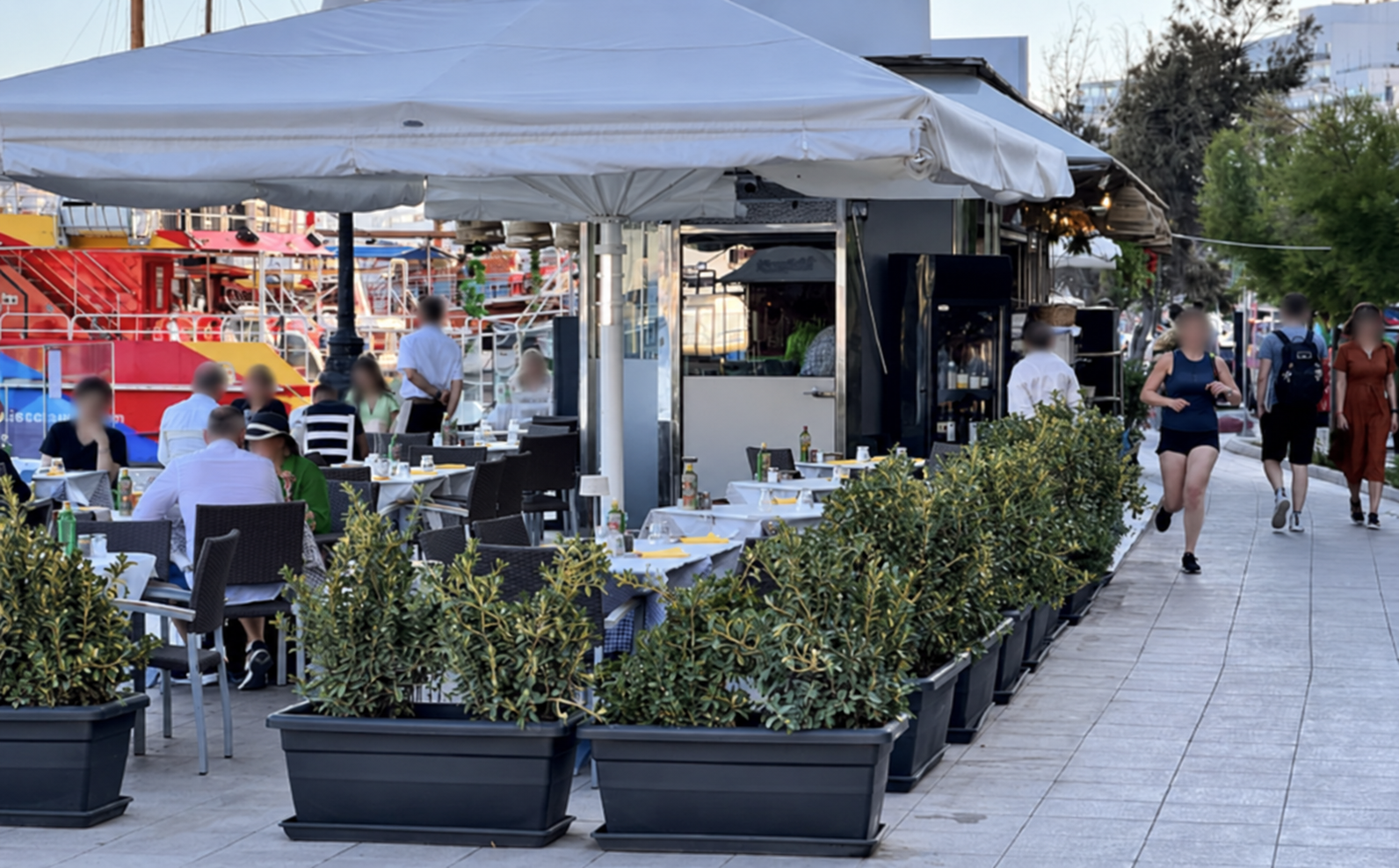

Walk through Sliema, Gżira, Valletta, St Julian’s, Marsaxlokk, Victoria or almost any heavily commercialised area in Malta and Gozo and the same question keeps coming back:
Outdoor dining is not the problem.
Restaurants, cafés and bars can add life to our streets and squares.
The problem starts when tables, chairs, umbrellas, planters, menu boards, barriers and serving stations begin taking priority over the people the pavement or street was designed to serve.
Pedestrians are pushed into narrower gaps. Parents have to manoeuvre pushchairs around furniture. Wheelchair users and people with reduced mobility may find a supposedly public route increasingly difficult to use.
And there is a much more serious question:
What happens when access is needed urgently?
The Rules Are Clearer Than Many People Realise
Malta’s Outdoor Catering Area policy contains requirements covering pedestrian access, permitted covers and the delineation of authorised outdoor areas.
Malta’s Outdoor Catering Area policy provides for a minimum clear pedestrian passage of
1.5 metres, including access for wheelchair users and people with prams and buggies.
The word clear matters.
A nominal 1.5 metres is little use if part of that space is then occupied by planters, menu boards, chairs pulled backwards from tables, people waiting to be seated or other objects.
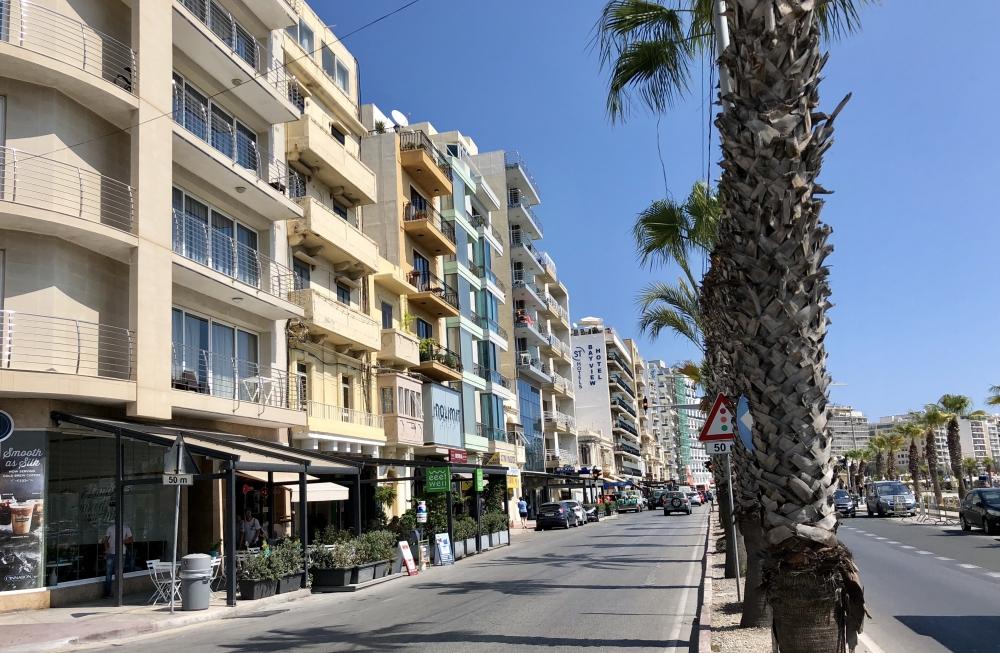
Photo: Malta Gone Wild.
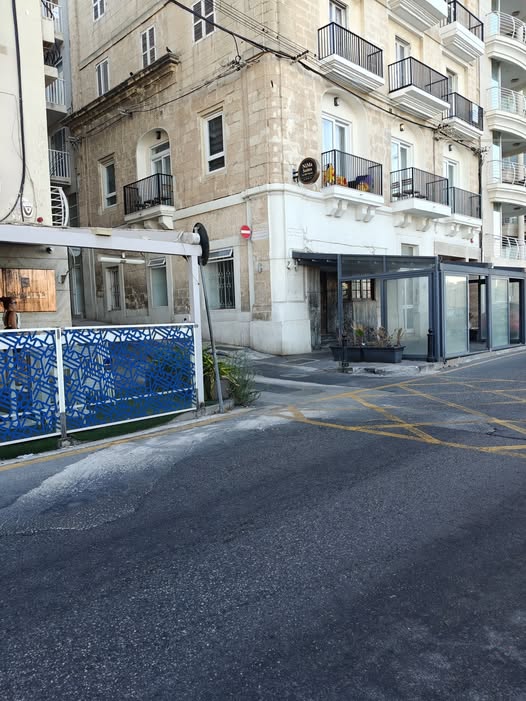
Photo: Malta Gone Wild.
A badly obstructed pavement is frustrating on an ordinary afternoon.
During an emergency, the consequences can be far more serious.
Emergency crews need rapid access. Tables or barriers can force a vehicle to stop farther away or wait while furniture is moved.
A fire appliance may need room not merely to pass, but to position itself close enough to a building to operate effectively.
Homes and businesses still need deliveries, repairs and utility access. Obstructions can push those vehicles elsewhere and create further congestion.
Waste collection, street cleaning and maintenance also require workable access through public spaces.
A wheelchair user or person with reduced mobility should not be forced towards the road simply because furniture occupies the safer route.
Clear routes also matter when people need to evacuate or responders need to reach somebody quickly on foot.
This Is Not Hypothetical
In August 2024, an ambulance responding to a patient in Valletta was delayed after tables, chairs and umbrellas obstructed its route through St Lucia Street.
Restaurant staff and members of the public had to move outdoor furniture so the ambulance could pass.
Reports said it was at least the second documented incident that year involving an emergency vehicle struggling through Valletta streets congested with outdoor catering furniture.
In Victoria’s St George’s Square, an ambulance responding to a man suffering a heart attack encountered shop stands, tables and chairs blocking access.
The ambulance driver was filmed getting out of the vehicle and physically moving tables and chairs himself before being able to gain better access.
It was not established that the obstruction affected the patient’s eventual outcome, so MGW is not making that claim. But emergency responders should never have to spend precious time clearing restaurant furniture before reaching somebody in distress.
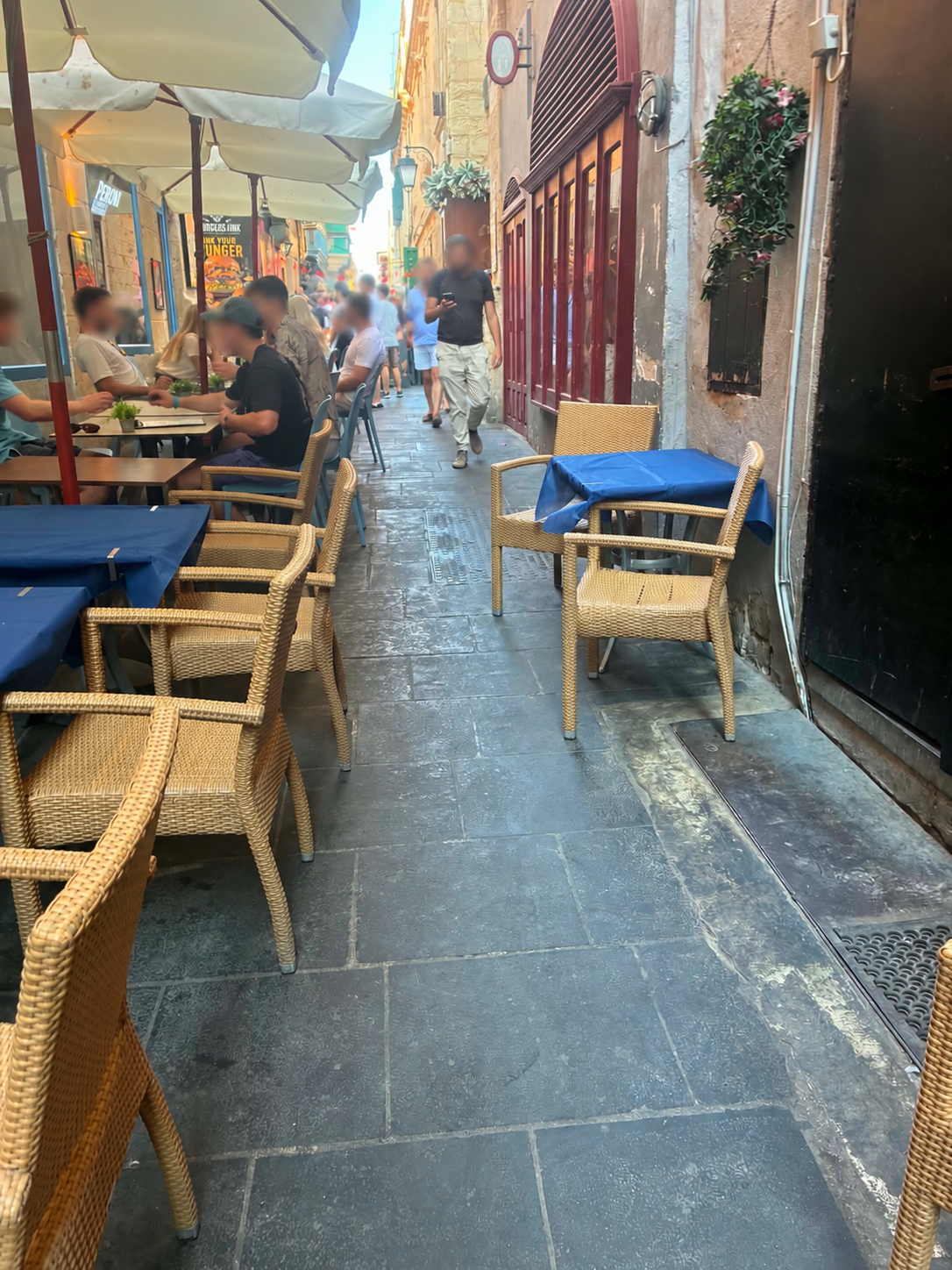
Faces blurred for privacy. This image illustrates pressure on public space and does not, by itself, establish that the pictured establishment is in breach.
Photo: Malta Gone Wild.
Transport Malta’s published technical conditions also state that tables and chairs should not create a safety hazard for pedestrian or vehicular traffic, and allow tables and chairs to be removed for safety reasons.
The Ombudsman Says the Problem Is Systemic
In January 2026, the Office of the Parliamentary Ombudsman called for firm action over the obstruction of public pavements and spaces, particularly by outdoor catering establishments.
It described the unchecked spread of tables, chairs and related furniture as a serious and continuing issue affecting safe mobility, equal access and public safety. :contentReference[oaicite:2]{index=2}
Residents should be able to see exactly how much public land has been granted.
The commercial area should be identifiable on the ground.
A permit means little if nobody checks whether the actual layout still matches it.
Illegal or unsafe obstructions should not simply remain until somebody complains repeatedly.
The Number of Tables Is Not Supposed to Be Unlimited
There is another part of the system that rarely gets discussed: the permitted number of covers.
The Outdoor Catering Area policy says the permitted number of outdoor covers should take into account the amount of space available and the establishment’s ability to cater for them.
An establishment should not simply continue adding tables because another one can physically be squeezed in.
There should be an approved footprint, approved furniture and an authorised seating capacity.
So who is actually counting?
So Who Is Actually Responsible?
One of the biggest weaknesses in the system is that responsibility is split between several different authorities.
Licences catering establishments and oversees their licensed operation.
Controls the authorised occupation of Government-owned public land, including relevant encroachment concessions.
Planning permission and approved layouts can form part of the regulatory framework for outdoor catering areas.
Obstruction, traffic, accessibility and public-safety issues can bring further authorities into the picture.
That explains why the system is complicated. It does not justify residents having to chase multiple authorities before somebody takes ownership of an obvious access problem.
Sliema & Gżira: 68 Table-and-Chair Encroachments
Figures tabled in Parliament in April 2024 concerning table-and-chair encroachments on public land. An authorised concession is not evidence of a breach. The question is whether the area actually occupied matches what was approved.
Where Are the Boundary Markers?
Approved outdoor catering areas are supposed to be physically identifiable.
That is important because a visible boundary would make enforcement dramatically easier.
An inspector could immediately see whether tables, chairs, umbrellas or planters had spread outside the concession.
So could the public.
An extra table can disappear before an inspection.
A planter can be shifted.
A row of chairs can be removed and put back later.
That is exactly why regular — and where appropriate unannounced — inspections matter.
The photographs in this article illustrate the practical impact that outdoor furniture can have on public space. Their inclusion does not establish that any particular establishment pictured is operating illegally or outside its authorised concession. The relevant permits and approved layouts must be checked before reaching that conclusion.
The Public Shouldn’t Have to Guess
For every catering establishment using public land, residents should be able to answer these questions quickly:
Put the Permits Online
There is a straightforward transparency solution: create a searchable public map or register of outdoor catering concessions.
For each establishment, the public should be able to see:
- the exact approved outdoor footprint;
- the number of permitted external covers;
- the number of permitted internal covers;
- the relevant Lands Authority concession;
- the approved planning layout where applicable;
- the pedestrian corridor that must remain clear;
- any emergency or vehicle-access conditions;
- the date of the latest inspection;
- and any enforcement action currently in force.
Transparency protects residents.
It also protects compliant businesses from being wrongly accused.
And it removes one of the biggest problems with the present system: the public cannot easily see where the legal boundary actually is.
JUST BECAUSE NOBODY IS CHECKING.
Outdoor dining has a place in Malta and Gozo.
But so do pedestrians.
So do wheelchair users.
So do parents with prams.
So do deliveries and public services.
And when something goes seriously wrong, so do ambulances and fire engines.
Public space has to work for all of them — not just for whoever can fit the most tables into it.
If restaurant or café furniture appears to seriously restrict a pavement, promenade, pedestrian area or narrow street, send us the exact location, establishment name, date and clear photographs showing the entire width of the public space.
Where possible, MGW will compare what is happening on the ground with the relevant permits, approved layouts and public-land concessions.
No guessing. No blanket accusations. Let’s check what was actually approved.
Malta Tourism Authority – Catering Establishment Licensing
Policy, Guidance and Standards for Outdoor Catering Areas on Public Open Spaces
Lands Authority – Public Land and Encroachments
Parliamentary Ombudsman – Safe and Unobstructed Pavements
Transport Malta – Technical Conditions for Tables and Chairs
Times of Malta – Ambulance Delayed by Tables and Chairs in Valletta
Times of Malta – Furniture Removed Following Valletta Ambulance Incident
Times of Malta – Ambulance Access Obstructed During Gozo Heart-Attack Emergency
68 Table-and-Chair Encroachments in Sliema and Gżira