

Residents of St Julian’s who have been living with the unfinished works in Triq il-Kbira for months may finally be seeing some pressure being applied where it matters.
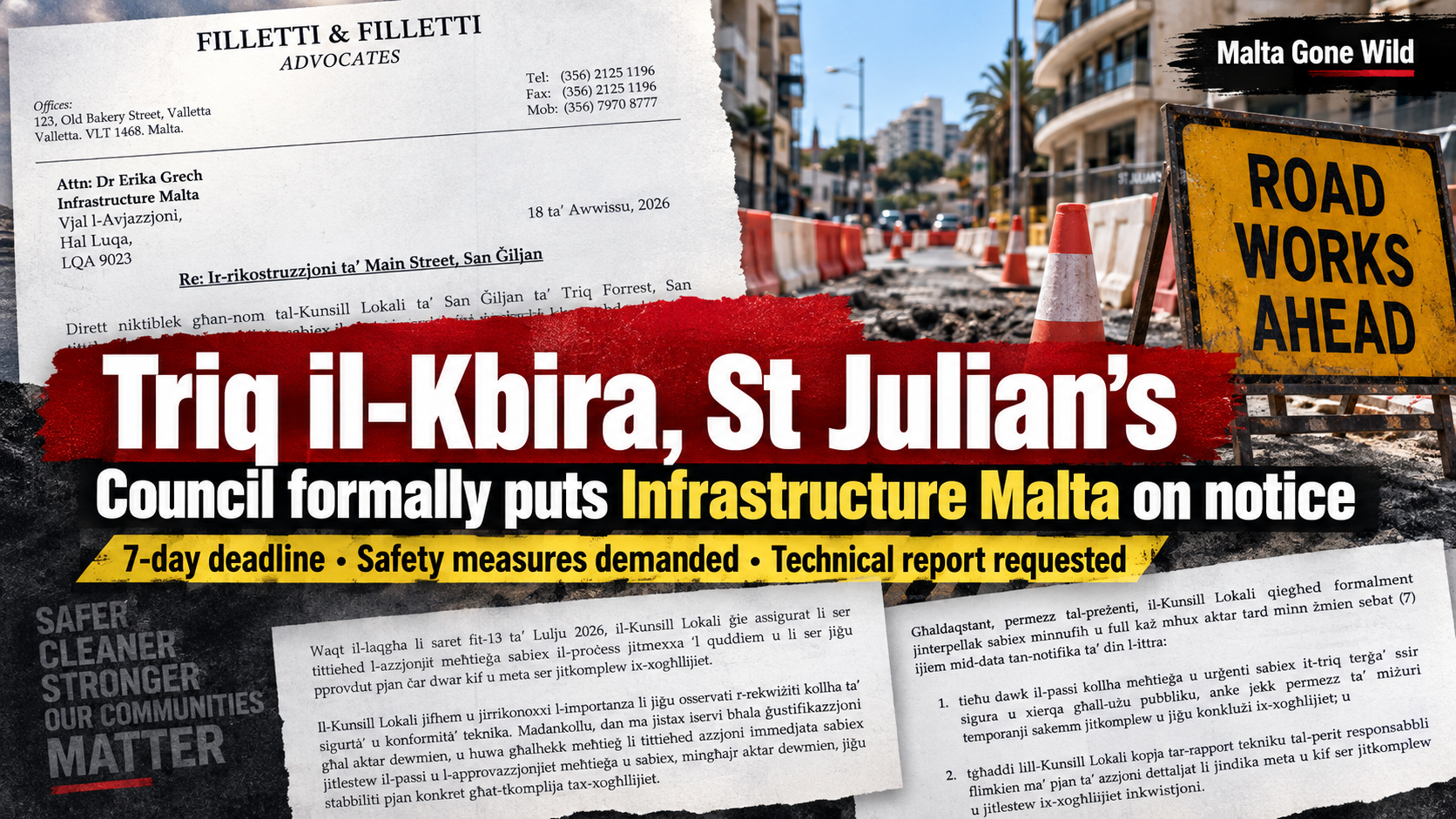
The St Julian’s Local Council has formally written to Infrastructure Malta through its lawyers, demanding action over the prolonged state of Main Street.
And credit where it is due: this is exactly the kind of intervention residents should be able to expect when repeated requests and meetings fail to produce results.
Works stopped — residents were left with the consequences
According to the Council, reconstruction works in Triq il-Kbira began several months ago before subsequently coming to a halt.
The issue appears to involve the section leading towards the courtyard of private apartments in Triq Gorg Borg Olivier, with questions arising over who is responsible for rectifying the underlying problem.
A meeting was eventually held in an attempt to establish responsibility and determine how the works could proceed.
A meeting was held involving Infrastructure Malta architects, the contractor’s architect, the Mayor, the Council’s lawyer and Infrastructure Malta’s lawyer.
According to the Council, an independent architect was to establish whether the remedial works were the responsibility of the private property owners or Infrastructure Malta.
The Council says repeated attempts to obtain an update failed to produce either the promised technical report or a clear plan for continuing the works.
The Council formally escalated the matter through Filletti & Filletti Advocates.
Council sends formal legal letter
On 18 August, the Council moved beyond requests for updates and formally escalated the issue.
Through Filletti & Filletti Advocates, it wrote to Infrastructure Malta arguing that the situation could not remain unresolved indefinitely while technical procedures and approvals remained pending.
The Council’s position is important: necessary engineering and safety procedures must be followed, but that should not mean leaving a major public road unfinished and potentially unsafe for months.
If permanent works cannot proceed immediately, temporary measures can still be taken to make the road reasonably safe and usable until the underlying issue is resolved.
Damage, dust and public safety concerns
The legal correspondence refers to complaints the Council says it received from residents and businesses affected by the situation.
Complaints linked to the condition of the road.
Concerns over risks created by unfinished works.
Persistent dust affecting residents and businesses.
Complaints reportedly involving respiratory problems and asthma.
Disruption affecting festivities and cultural activities.
Residents and businesses continue to face the consequences.
Triq il-Kbira is not a forgotten side road. It is one of the main routes through St Julian’s and is continuously used by residents, businesses, visitors and service vehicles.
Leaving it in a compromised condition indefinitely was clearly becoming unacceptable.
The Council also requested a copy of the technical report and a detailed action plan setting out when and how the outstanding works would resume and be completed.
The letter also reserves the Council’s rights. Should action not be taken, the Council states that it may take whatever steps are necessary to protect residents’ interests, including in relation to damage, losses, expenses
or third-party claims arising from the situation.
That gives the intervention considerably more weight than another round of emails asking when the works might restart.
Read the Council’s legal letter
The original legal correspondence is reproduced below so residents can read exactly what was communicated on behalf of the Council.
Malta Gone Wild regularly criticises councils, authorities and government entities when residents are left chasing answers for months.
So when a Local Council actually escalates a problem on behalf of its residents, that deserves recognition too.
In this case, the Council appears to have tried dialogue first. A meeting was held, a technical report was promised and updates were requested.
When that failed to produce a clear resolution, the matter was formally escalated.
Local Councils may not control Infrastructure Malta or national infrastructure budgets, but they can document problems, demand answers and use the channels available to them to defend residents’ interests.
Too often people are told that an issue has been “referred to the relevant authority”, only for it to disappear into an administrative black hole.
In this case, St Julian’s Local Council appears unwilling to simply leave it there.
Now Infrastructure Malta needs to respond
The legal letter was dated 18 August and gave Infrastructure Malta seven days to act. That deadline has long since passed.
Residents therefore deserve clear answers:
- Has the independent technical report been completed?
- Has responsibility for the underlying problem been established?
- What temporary safety measures have been introduced?
- Has Infrastructure Malta provided a detailed action plan?
- When will the works restart?
- When will Triq il-Kbira finally be completed?
The Council has taken a welcome step. The ball is now firmly in Infrastructure Malta’s court.