
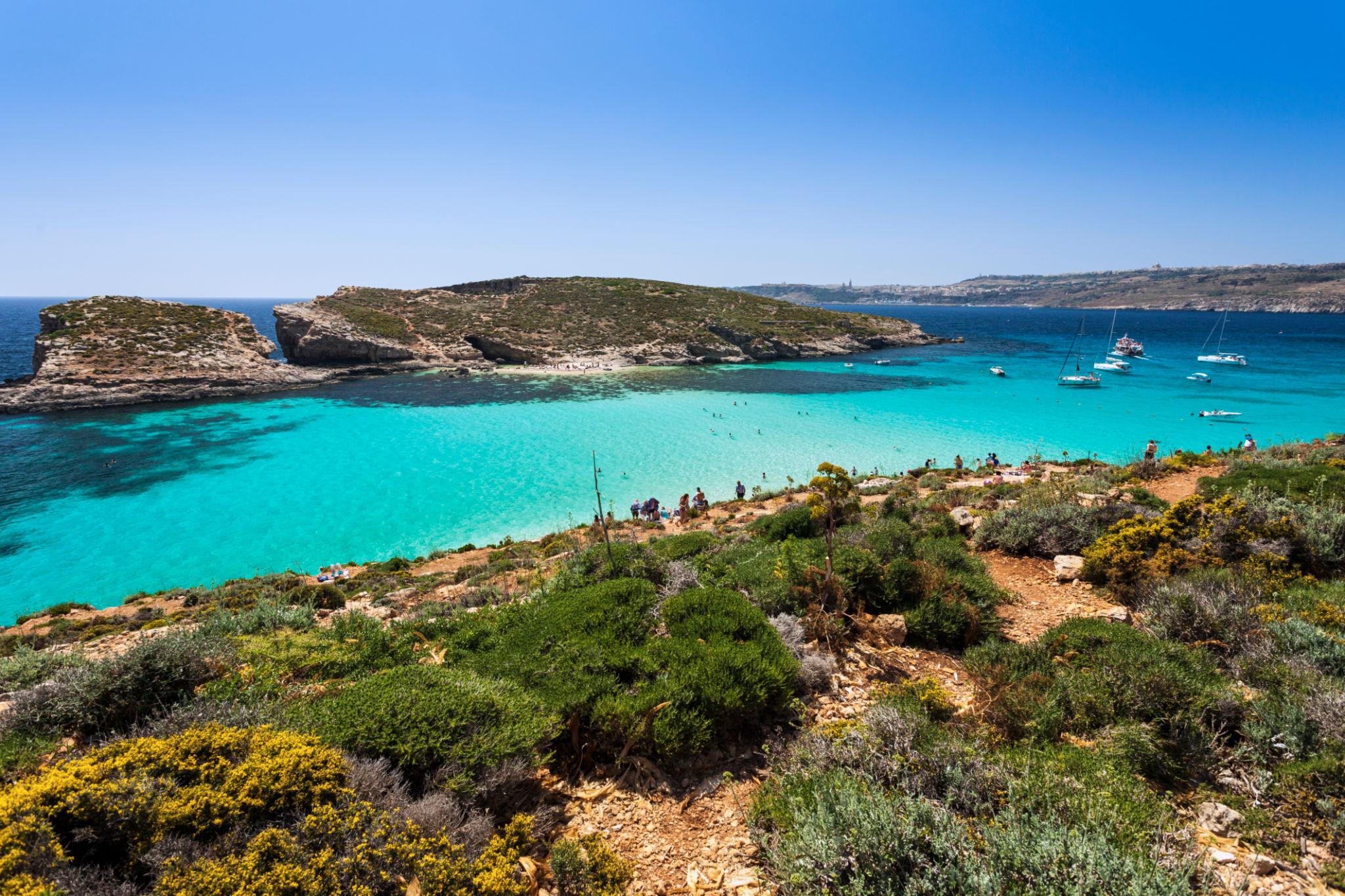

A new Save Comino crowdfunding campaign has been launched by Moviment Graffitti as environmental concerns intensify over plans that could see hundreds of trees and shrubs removed from Comino to make way for the controversial redevelopment of the former Comino Hotel and bungalow complex.
The campaign aims to raise funds to appeal a recent Environment and Resources Authority (ERA) permit and support further action to protect Comino from development.
At the centre of the controversy is a proposed tourism development on one of Malta’s most environmentally sensitive islands.
What has actually been approved?
ERA confirmed that 678 trees and shrubs are permitted to be removed from the development area. Among them are 54 protected trees, while 92% of the specimens scheduled for removal are classified as non-protected species.
The permit also allows another 348 trees to be transplanted, including 341 protected specimens.
Among the trees and shrubs permitted for removal are:
- 33 protected Aleppo pines
- 21 protected cypress trees
- 468 oleanders
- 125 Mexican fan palms
- 31 Canary Island date palms
Moviment Graffitti has referred more broadly to the impact on around 800 trees, while ERA’s official clarification states that 678 trees and shrubs are to be removed under the permit.
That distinction is worth making, but it does little to reduce the scale of what is being proposed.
A nature reserve making way for a luxury resort?
The tree interventions are linked to the redevelopment of the former Comino Hotel and bungalow area at San Niklaw Bay and Santa Marija Bay.
The approved plans include a new hotel, villas and numerous swimming pools. The Planning Authority permit remains subject to an ongoing appeal.
This raises a fundamental question:
How much development should ever be considered acceptable on an island that is supposed to be protected?
Comino is not simply an empty piece of land waiting to be developed. Its landscape, vegetation and relatively undeveloped character are precisely what make the island valuable.
Once mature vegetation is removed and construction infrastructure enters the area, some of those changes may be extremely difficult, if not impossible, to reverse.
ERA says hundreds of new indigenous trees will be planted
ERA has defended its decision and says the developer will be required to plant 540 indigenous trees, representing ten new trees for every one of the 54 protected trees being removed.
Trees that are unsuccessfully transplanted must also be replaced at a ratio of ten to one.
On paper, those numbers may sound reassuring.
But the Malta Chamber of Scientists has raised an important concern: a mature tree cannot simply be considered environmentally equivalent to ten newly planted saplings.
Established trees already provide canopy, habitat, carbon storage and soil stabilisation. Replacement planting only becomes meaningful if those young trees survive and are properly maintained for many years.
The Chamber has also questioned the wider cumulative impact of the project, including water demand, swimming pools, waste generation, construction activity and additional pressure on an ecosystem already heavily affected by summer tourism.
Why are irreversible works possible while an appeal is still ongoing?
Perhaps the most troubling part of the situation is that the Planning Authority approval is still being challenged.
HV Hospitality has said that demolition and construction of the hotel and bungalows will not begin until the planning appeal has been concluded.
However, the developer has not given the same assurance regarding the permitted tree works. It has said transplantation, pruning and uprooting must take place during the winter months, but has not confirmed that these interventions will wait until the planning appeal is finally decided.
That creates an obvious concern.
What happens if trees are removed while the development remains under appeal, and the appeal later results in the project being altered or overturned?
A legal victory months later cannot put a mature tree back into the ground.
Crowdfunding campaign launched to challenge the decision
Moviment Graffitti has now launched a crowdfunding campaign to finance an appeal against ERA’s decision and support further action aimed at protecting Comino.
The organisation says an appeal by itself does not automatically stop the works from proceeding, and it is therefore also calling on members of the public to remain alert for future actions.
Those wishing to support the legal and campaigning effort can contribute through the Save Comino fundraiser:
Support the Save Comino campaign
This is bigger than 678 trees
The debate over Comino should not be reduced to a mathematical exercise involving how many trees are removed and how many saplings are planted afterwards.
The bigger question is what kind of future Malta wants for the few remaining areas that have escaped intensive development.
Malta and Gozo have already experienced decades of construction, loss of open spaces and increasing pressure on the natural environment.
Comino should surely be one of the places where the threshold for development is highest, not simply another location where environmental damage is considered acceptable because mitigation measures can be attached to a permit.
Development can be rebuilt.
Swimming pools can be redesigned.
Hotels can be relocated or reduced.
But once a fragile natural landscape is permanently altered, getting it back is considerably more difficult.
The public deserves clear answers about why potentially irreversible environmental interventions should be allowed to proceed while the underlying development remains under appeal.
And Comino deserves more than promises of replacement trees after the damage has already been done.
Source and campaign: Moviment Graffitti Save Comino crowdfunding campaign, ERA statements, Malta Chamber of Scientists and publicly reported planning information.