
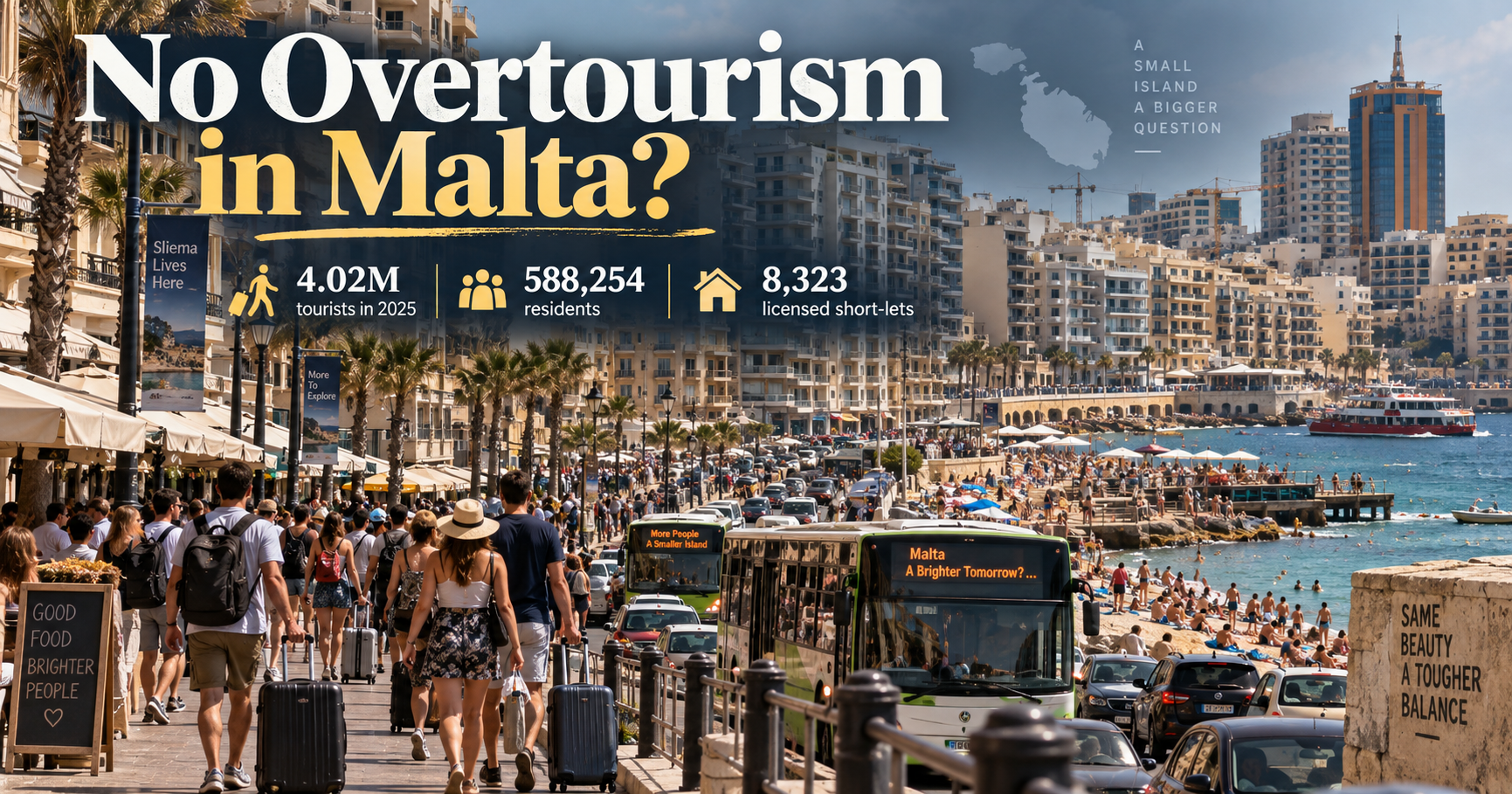

The head of the World Travel & Tourism Council has said Malta does not have an overtourism problem — at least not yet. But with more than four million tourists arriving in a country of fewer than 600,000 residents, perhaps it is worth looking beyond the label and asking a much simpler question: how much more can Malta actually handle?
According to the National Statistics Office, Malta welcomed 4,022,310 inbound tourists during 2025.
The country’s estimated resident population at the end of the same year was just 588,254.
That works out at approximately 6.8 tourist arrivals for every person living in Malta and Gozo during a single year.
And 2026 is growing even faster
This is not simply a discussion about last year’s record.
During the first five months of 2026, Malta received 1,673,602 inbound tourists — an increase of 17.9% compared with the same period in 2025.
May alone brought an estimated 457,636 visitors, up 22.3% year-on-year.
Industry figures have already suggested Malta could reach around 4.5 million tourists in 2026.
Tourism is unquestionably important to Malta’s economy. Nobody is seriously suggesting Malta should shut the door on visitors.
But economic importance does not mean growth should be unlimited.
More than 8,300 licensed short-lets
Accommodation is also spreading far beyond Malta’s traditional hotel areas.
The Malta Tourism Authority’s public register currently lists approximately:
- 7,120 licensed short-let properties in Malta
- 1,203 licensed short-let properties in Gozo
- 8,323 licensed short-lets in total
That is roughly one licensed short-let property for every 71 residents in Malta and Gozo.
And remember: we are talking about properties, not individual tourist beds.
Thousands of tourist properties now sit inside ordinary residential streets and apartment blocks.
That brings tourism directly into communities — together with additional waste, noise, traffic, luggage transfers, taxis, delivery vehicles and pressure on residential infrastructure.
Hotels are expanding too
Short-lets are only one part of the accommodation picture.
In June 2026, Malta and Gozo had 368 active collective accommodation establishments, providing 56,329 tourist bed-places.
That includes hotels and other forms of collective tourist accommodation — sitting alongside the thousands of licensed short-let properties operating across the islands.
Then add the resident population
Tourists do not arrive on an empty island.
Malta’s resident population reached approximately 588,254 at the end of 2025, an increase of 2.4% in just one year.
Some areas are already extraordinarily dense.
Tas-Sliema, for example, had a resident population density of approximately 18,186 people per square kilometre at the end of 2025.
That number does not include the thousands of tourists staying in hotels and short-lets at any particular time.
And 457,000 vehicles
At the end of 2025, Malta also had 457,403 licensed motor vehicles.
During the final three months of the year alone, the vehicle stock increased at an average net rate of 35 vehicles every day.
Tourists obviously do not each bring a car with them, but millions of additional visitors generate demand for:
- rental cars
- taxis and ride-hailing vehicles
- coaches and minibuses
- airport transfers
- tour buses
- delivery and service vehicles
All of that movement takes place on the same roads residents already use every day.
So what exactly counts as “overtourism”?
There is no magical number at which a country suddenly crosses a line and officially becomes “overtouristed”.
The more useful question is whether tourism has grown beyond the capacity of a destination to absorb it without seriously damaging residents’ quality of life, the environment, infrastructure or the visitor experience itself.
Look around Malta and the pressures residents repeatedly complain about include:
- traffic congestion
- overcrowded buses
- waste piling up in tourist areas
- pressure on beaches and public spaces
- short-lets replacing residential accommodation
- noise in residential neighbourhoods
- pressure on electricity, drainage and water infrastructure
- crowded pavements and public areas
- continuous hotel and accommodation development
Tourism is valuable. That does not mean more is always better.
Tourism generated an estimated €3.9 billion in expenditure during 2025. It supports thousands of jobs and businesses and gives Malta exceptional air connectivity for a country of its size.
The objective should therefore not be to attack tourism or tourists.
The question is whether Malta should continue measuring tourism success primarily through ever-higher arrival numbers.
Fewer pressures, better enforcement, higher-quality tourism, longer stays, better visitor spending and a tourism industry that improves rather than diminishes the places where Maltese and Gozitan residents actually live.
Quality over quantity?
Consider two scenarios.
Scenario A: Malta attracts hundreds of thousands more visitors every year, requiring more accommodation, more transport, more workers and more infrastructure simply to service continually increasing volumes.
Scenario B: Visitor growth stabilises while Malta focuses on attracting travellers who stay longer, spend more, visit outside the busiest periods and contribute more to local businesses.
Which model leaves Malta better off in ten years?
Residents do not need an international label to know when somewhere feels overcrowded
Perhaps Malta does not meet somebody’s technical definition of overtourism.
Perhaps we are merely approaching it.
But residents experiencing packed roads, overflowing bins, crowded buses, construction, short-lets and increasingly congested public spaces might understandably wonder exactly what has to happen before the problem is acknowledged.
“How many more tourists can Malta attract?”
It should be:
“How many tourists can Malta comfortably handle?”
Tourism should make Malta more prosperous.
It should not require residents to accept a steadily declining quality of life simply because another tourism record looks good in a headline.
And if Malta is already exceeding four million visitors a year, with the resident population, accommodation stock and tourism numbers all continuing to rise, then discussing the country’s carrying capacity is not anti-tourism.
It is common sense.