
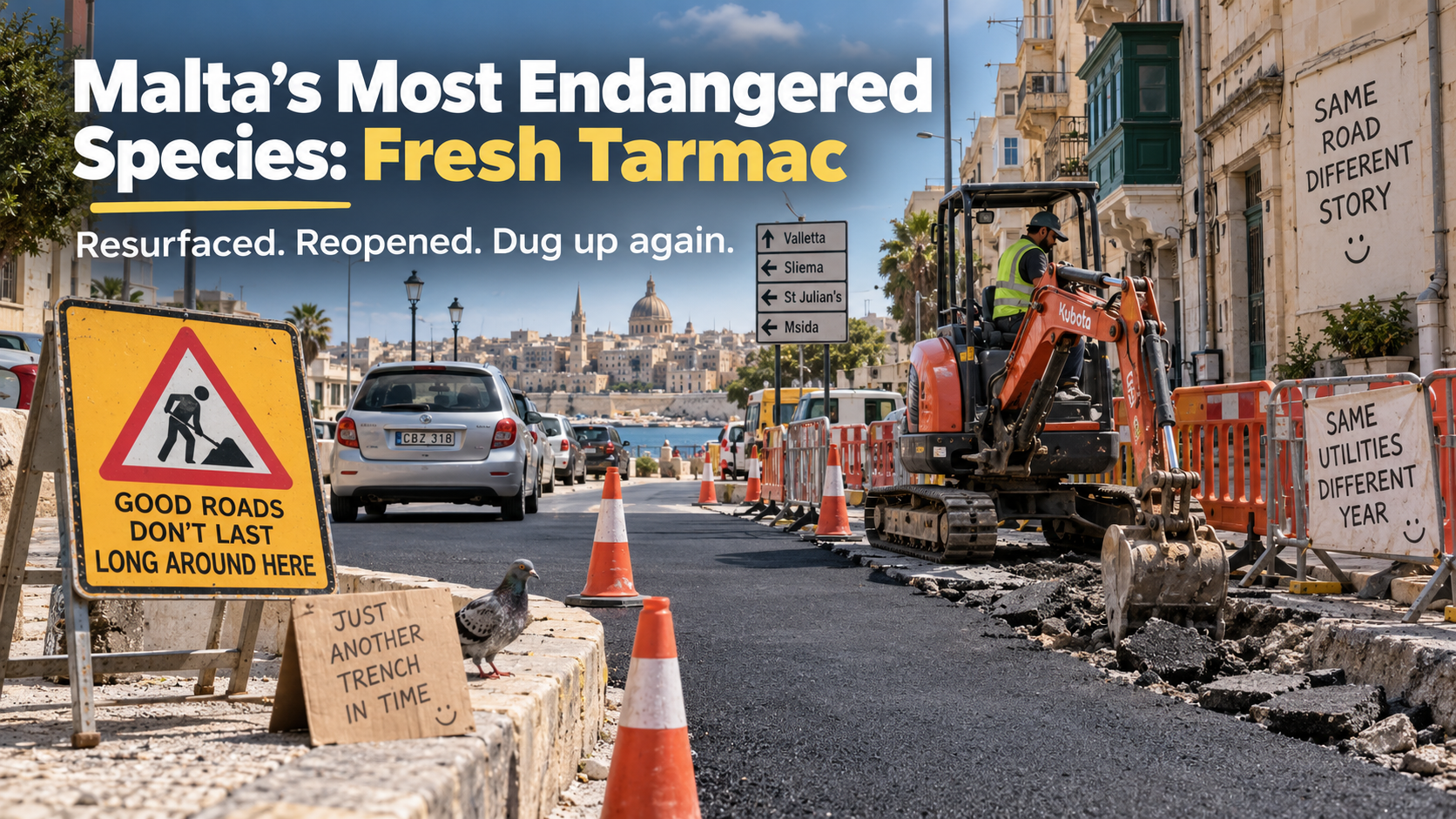

In Malta, freshly laid tarmac doesn’t come with a lifespan. It comes with a countdown.
Four months ago, Triq Għajn Dwieli — the road linking Paola with Cottonera — received some fresh asphalt in the run-up to the general election.
It looked smooth. It looked clean. It looked almost… permanent.
Rookie mistake.
The excavators are now back and sections of the road are being dug up again for new Water Services Corporation infrastructure.
According to the WSC, works started on 31 August and are expected to take around four weeks. The project involves new potable-water and wastewater infrastructure, including a new main connecting the Qrendi reservoir to the network supplying the Three Cities and surrounding areas.
And to be fair, that infrastructure has a very real purpose: providing an alternative water supply route if another part of the network fails.
So why asphalt the road first?
That is naturally the small detail which caught everyone’s attention.
Infrastructure Malta says the resurfacing carried out four months ago was never meant to be the road’s grand finale.
It says parts of Għajn Dwieli had deteriorated so badly that they were posing a serious danger to motorists, so it carried out a “temporary, minimal and localised intervention” until the Water Services Corporation could begin its planned project.
In other words:
Step 1: Fix road.
Step 2: Enjoy road briefly.
Step 3: Dig road.
Step 4: Presumably fix road again.
The resurfacing also happened in the run-up to the election and the road lies in one of the districts contested by then-infrastructure minister Chris Bonett. That timing was reported earlier this year when questions were raised about the concentration of roadworks in the minister’s electoral districts.
Timing alone, of course, does not establish why a particular road was resurfaced. Infrastructure Malta has said its programme is based on infrastructure needs, technical assessments, council coordination and operational requirements.
Relax. We’ve seen this episode before.
Triq Għajn Dwieli is certainly not the first Maltese road to experience reincarnation.
In Mosta, Triq il-Kbira spent around two years undergoing works before reopening. Not long afterwards, sections had to be worked on again when stormwater gratings were found to be defective. The mayor said the faulty components would be replaced at the supplier or contractor’s expense.
Elsewhere in Mosta, Triq il-Fortizza was cited in 2024 after reportedly spending almost three years being rebuilt — only for machinery to return shortly afterwards so utility services could be installed.
Then there was Tower Road in Sliema. Back in 2019, around €830,000 was spent resurfacing the arterial road even though a more comprehensive reconstruction was already planned for the following months. The explanation at the time was that the road had deteriorated enough to require urgent intervention.
And perhaps our personal favourite comes from Triq l-Għassara tal-Għeneb near the Valletta Waterfront.
Workers returned with the diggers in 2012 barely a week after the rebuilt road had reopened, this time to deal with problems around a manhole.
One week.
That tarmac barely had time to update its Facebook relationship status to “It’s complicated.”
The traditional Maltese road life cycle
At this point we may need to stop thinking of roads as finished infrastructure and start treating them as seasonal installations.
Fresh asphalt arrives.
Everyone admires it.
Someone remembers there is a pipe underneath it.
A digger appears.
A trench is opened.
A patch is added.
Several months later another utility company discovers the same street.
Repeat until the road resembles a patchwork quilt capable of destroying a suspension system.
The joke is funny because the problem isn’t
There are legitimate reasons why emergency repairs and utility upgrades sometimes require newly surfaced roads to be reopened. Water, electricity, sewage and telecommunications infrastructure cannot simply be ignored because the asphalt looks nice.
But Malta has had variations of the same story for years: resurfacing, excavation, patching and resurfacing again.
And every repeat means more traffic disruption, more dust, more machinery, more inconvenience and potentially more work on infrastructure that motorists thought had already been completed.
Perhaps one day we will achieve the revolutionary concept of putting everything that needs to go under the road… under the road before finishing the road.
Until then, enjoy Malta’s fresh tarmac whenever you see it.
Take a photograph.
It may not be there for long.