
This summer should have been a wake-up call.
St Julian’s, Paceville, Swieqi, Sliema and Gżira were bursting at the seams.
Drunken behaviour, shouting in residential streets, public urination, fights,
parties, drugs, vandalism and general anti-social behaviour became an almost
routine part of summer life in some of Malta’s busiest areas.
And far too often, residents were left wondering:
where are the police?
Malta cannot continue attracting millions of visitors, packing thousands of
people into nightlife districts and allowing short-let accommodation to spread
throughout residential neighbourhoods while policing these areas as though we
are still a sleepy Mediterranean village.
We aren’t.
Our police force needs to be better trained, better equipped and far more visible.
One teenager. Five police officers.
A court case reported by
The Malta Independent
should have raised serious questions.
Police approached a 19-year-old French tourist after he was caught urinating in
public outside Sky Club in Paceville.
After officers reportedly spent around 20 minutes trying to get him to settle a
€150 fine, the teenager ran away.
Police caught up with him.
According to evidence given in court, five police officers then moved in
to restrain him.
During a struggle lasting around 25 seconds, the teenager reportedly managed to
overpower the officers, force them to the ground and escape.
Other people became involved in the commotion, and a second 19-year-old was later
identified from CCTV as having participated in the scuffle.
Both men later pleaded guilty to a number of offences.
There is absolutely no excuse for attacking, obstructing or resisting police.
But there is still one very obvious question:
How does one 19-year-old manage to overpower five police officers and escape?
That is not simply a question about the officers involved.
It is a question about the level of training they are being given.
Police need more than a uniform
Modern frontline policing requires much more than knowing the law and being
physically fit.
Officers need continuous hands-on training in dealing with violent, intoxicated,
unpredictable and aggressive individuals.
They need to know how to position themselves, how to communicate under pressure,
how to restrain someone safely, and how several officers should work together
during a physical intervention.
These skills cannot simply be taught once at the police academy and then assumed
to remain sharp for years.
They need to be practised repeatedly.
In a real confrontation, everything happens within seconds.
There is no time for officers to stop and discuss who does what.
Teamwork, technique and muscle memory matter.
And they need to be properly equipped
Better training alone is not enough.
Frontline officers also need proper modern equipment to protect themselves and
the public.
If police are expected to confront violent individuals, break up fights, deal
with people under the influence of alcohol or drugs and control crowds, then they
need the tools to do that safely.
That means appropriate protective equipment, effective communications, body
cameras, access to immediate backup and equipment suitable for high-risk public
order situations.
Police officers should not be sent into dangerous situations inadequately
prepared and then criticised afterwards when things go wrong.
This is not only about tourists
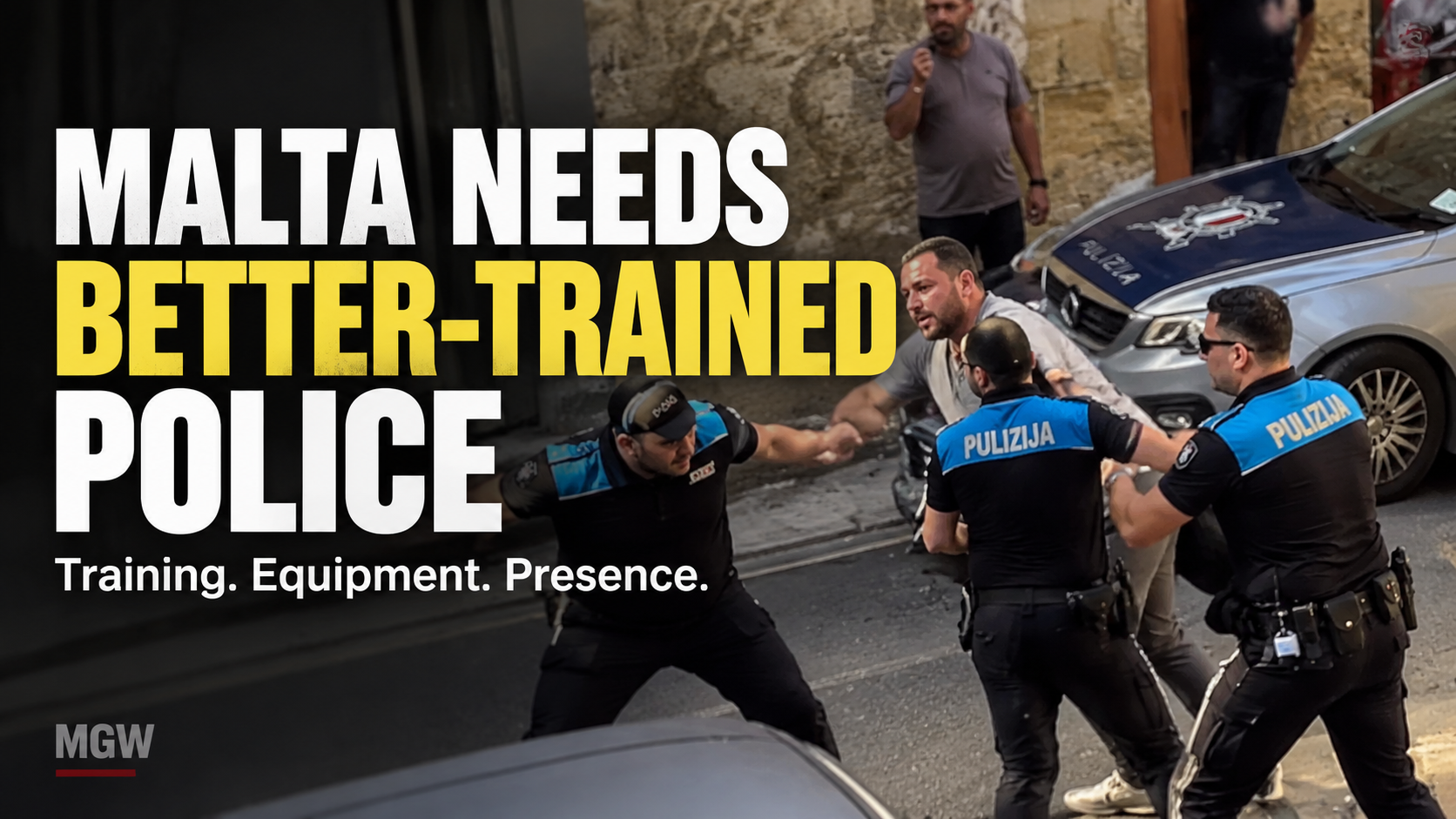
Malta Gone Wild was also sent footage from Valletta showing
three police officers physically dealing with one Maltese man.
A short video cannot tell us everything that happened before or after the
confrontation, and it would be irresponsible to judge either side purely from
one clip.
But the footage once again illustrates the type of physical situations frontline
officers are expected to handle.
Whether the person involved is Maltese, French, British or any other nationality
is beside the point.
The police need to be able to control the situation safely.
Where were the police this summer?
Training and equipment are only part of the problem.
The other is presence.
This summer, residents across St Julian’s, Paceville, Swieqi, Sliema and Gżira
repeatedly complained about noise, public urination, drunken behaviour, fights
and disturbances.
Eventually, the authorities increased police patrols and deployed additional
enforcement resources in several of these areas.
But these problems were hardly a surprise.
Summer arrives every year.
Paceville has existed for decades.
The growth of short-lets is not new.
Neither is the huge concentration of tourists in St Julian’s, Sliema, Gżira and
Swieqi.
Policing should be planned before the summer crowds arrive, not
after residents become fed up enough to complain.
We need police we can actually see
Visible policing matters.
A police officer walking through a street can stop trouble before it starts.
Regular patrols through known hotspots act as a deterrent.
People behave differently when they know enforcement is nearby.
Cameras, fines and enforcement notices all have their place, but none of them
replace trained police officers on the ground.
Malta needs a much stronger visible police presence during the busy season,
particularly in:
- Paceville
- St Julian’s
- Swieqi
- Sliema
- Gżira
- Bugibba and Qawra
- Valletta’s nightlife areas
And that presence must continue well into the early hours, when many of the
problems actually occur.
Nightlife policing should be specialised
There is a huge difference between ordinary daytime community policing and
working a packed nightlife district at 2am or 3am.
An officer dealing with a quiet neighbourhood dispute is operating in a very
different environment from one breaking up a fight outside a nightclub.
Malta should have more officers specifically trained in nightlife and public
order policing.
That includes dealing with:
- crowd behaviour
- alcohol-related violence
- drug-related agitation
- safe restraint
- coordinated physical intervention
- de-escalation
- public disorder
- rapid response and backup
And crucially, there need to be enough officers available.
More police does not automatically mean better policing
Politicians often announce that more officers have been deployed.
That sounds reassuring.
But numbers alone do not solve the problem.
Ten poorly prepared officers are not necessarily more effective than five
highly trained ones.
Training matters.
Leadership matters.
Equipment matters.
Coordination matters.
Experience matters.
The objective should not simply be to overwhelm somebody through numbers.
The objective should be to control the situation quickly, proportionately,
professionally and safely.
Malta is no longer a sleepy village
Malta has changed enormously.
Tourism has grown.
Nightlife has grown.
Short-lets have expanded.
Festivals and major events have expanded.
The number of people using our roads, beaches, entertainment districts and
residential areas has increased dramatically.
Yet some public services still appear to operate according to the mentality of
a much smaller Malta.
That cannot continue.
If Malta wants the economic benefits of mass tourism, then part of the cost is
providing enough police, enforcement, cleansing, transport and infrastructure
to cope with it.
You cannot invite the crowds and then leave residents and overstretched police
officers to deal with the consequences.
This is also about protecting police officers
Calling for better policing does not mean attacking the police.
Quite the opposite.
Imagine being sent into Paceville at 3am to deal with a violent and intoxicated
person.
You do not know whether that person has taken drugs, has a weapon, or has ten
friends standing behind them.
A crowd gathers.
Phones come out.
You have seconds to make a decision.
Those officers deserve excellent preparation.
They deserve backup nearby.
They deserve good equipment.
And they deserve enough colleagues on the streets so they are not constantly
being placed in impossible situations.
Malta needs three things
Better training. Better equipment. More police on the streets.
Not just during special operations.
Not just after another incident makes the news.
And not just when complaints become impossible to ignore.
It needs to become the normal standard in Malta’s busiest areas.
Because something is seriously wrong when five police officers attempt to
restrain one 19-year-old and he still manages to force his way free and escape.
Something is also wrong when residents spend summer after summer complaining
about the same drunken disturbances, public urination, fights and disorder.
Malta has changed.
Our police force needs the resources, training and manpower to change with it.
If we are going to continue pursuing ever-higher tourism numbers and ever-busier
nightlife districts, then providing a properly trained, properly equipped and
properly staffed police presence is not a luxury.
It is the minimum residents — and our police officers themselves —
should expect.