
Malta continues to break tourism records, while new hotels, guesthouses and short-let properties continue to enter the market.
But before Malta adds thousands more tourist beds, there is a fairly obvious question that deserves to be asked:
Do Malta and Gozo actually have a shortage of tourist accommodation?
The available official figures suggest that, nationally, there is little evidence of a general shortage of tourist beds at present.
And accommodation capacity is only one part of the equation.
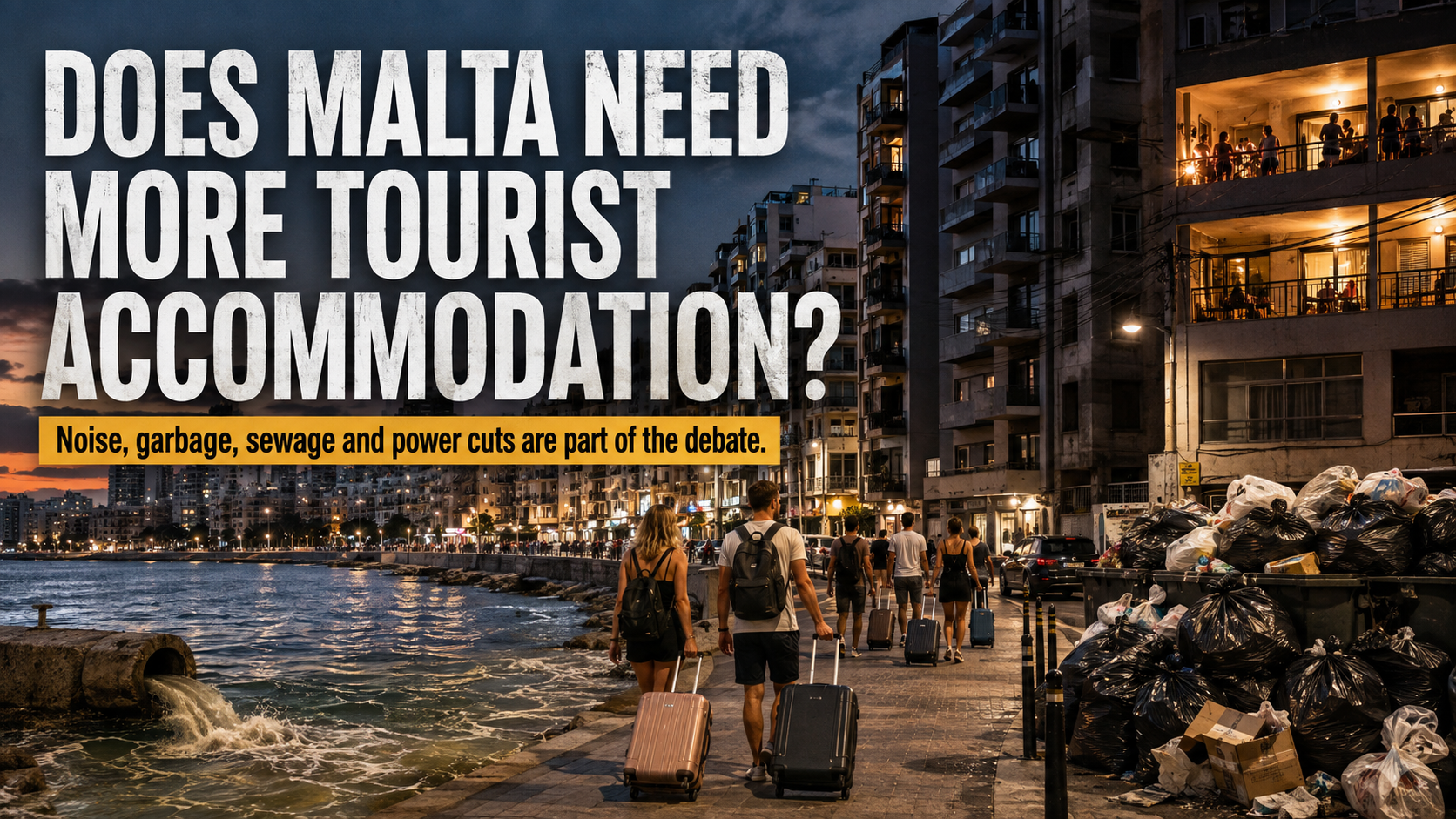
For people living in some of Malta’s busiest localities, the discussion is increasingly also about noise, rubbish, pressure on the drainage system, sewage incidents, electricity outages and whether Malta’s infrastructure and residential communities can comfortably absorb continued growth.
The question is no longer simply: Can we fit more tourists?
The question should be whether Malta’s infrastructure, environment and residential communities can comfortably sustain more tourism growth.
More than 31,000 short-let beds alone
Figures supplied in Parliament show that in October 2025 licensed Holiday Furnished Premises — the category covering much of Malta’s short-let tourist accommodation — provided 31,736 tourist beds across Malta and Gozo.
And that is only the short-let sector.
According to the National Statistics Office, in September 2025 there were 349 active collective accommodation establishments, including hotels, guesthouses, hostels and tourist villages, providing 53,211 bed places.
Source: National Statistics Office – Collective Accommodation Establishments Q3 2025
Taken together, those datasets indicate approximately 85,000 beds between collective accommodation and licensed Holiday Furnished Premises alone.
The figures relate to slightly different reference periods and should therefore be treated as an approximate comparison rather than one single official total.
Are those beds actually full?
This is perhaps the most important part of the discussion.
During the peak July-to-September 2025 quarter, the NSO reported that the net use of bed places in collective accommodation was 80.4% nationally.
In Malta it stood at 81.2%, while Gozo and Comino recorded 64.6%.
In other words, even during one of the busiest periods of the tourism year, Malta’s hotels, guesthouses, hostels and tourist villages were not operating at full bed capacity overall.
That does not mean every hotel had rooms available on every night. Particular areas, major events and individual weekends can obviously sell out.
But nationally, the official figures do not suggest a tourism industry that has simply run out of places for visitors to sleep.
Peak-season reality: collective tourist accommodation recorded approximately 80% bed occupancy during Q3 2025. That is extremely strong demand — but it is not evidence that Malta has exhausted its accommodation capacity.
Tourism is still growing rapidly
Demand is unquestionably increasing.
In June 2026 Malta welcomed 458,223 inbound tourists, an increase of 18.5% compared with June 2025.
Those tourists spent almost 2.58 million nights in Malta during that month.
That works out at roughly 86,000 tourists staying in Malta on an average June night.
Around 89.2% of guest nights were spent in rented accommodation, equivalent to approximately 76,700 rented-accommodation guest nights per day during June.
Source: National Statistics Office – Inbound Tourism, June 2026
The NSO definition of rented accommodation is wider than hotels and short-lets alone, so this cannot be compared directly bed-for-bed with the MTA licensing register.
Nevertheless, it gives a useful indication of the scale of Malta’s effective visitor population.
But where do residents fit into this?
Accommodation cannot be considered purely as a question of whether another visitor can find a bed.
Tourists do not disappear when they leave their accommodation in the morning.
They use the same roads, buses, beaches, promenades, electricity network, water supply, drainage system, waste collection services and public spaces as the people who live here.
That is completely normal — tourism is part of Malta’s economy and visitors are entitled to enjoy the islands.
But when deciding how much further tourism capacity should expand, the pressure created by the combined resident and visitor population cannot simply be ignored.
Noise and short-lets inside residential communities
Residents in tourism-heavy areas such as Sliema, Swieqi and St Julian’s have repeatedly raised concerns about noise and antisocial behaviour associated with some short-let accommodation.
In July 2026, Swieqi mayor Noel Muscat called for stronger legislation and enforcement following further incidents involving short-let properties.
Police subsequently intervened at a noisy gathering in a Swieqi apartment block where 12 people were fined, while the Malta Tourism Authority took action against accommodation operating in breach of licensing requirements.
Source: The Malta Independent – 13 July 2026
In Sliema, residents have similarly raised concerns about excessive noise, parties in short-let apartments, rubbish and disturbances within residential areas.
None of this means that every short-let or every tourist causes a problem.
Most visitors behave perfectly normally.
But the growth of short-let accommodation inside ordinary residential apartment blocks creates a particular challenge: tourist activity and permanent residential life are increasingly taking place behind the same front door.
A hotel has reception staff and a management structure responsible for guests.
For somebody living next door to a short-let, responsibility can be considerably less obvious when there is shouting, loud music or a party at 2am.
Garbage: growth also generates waste
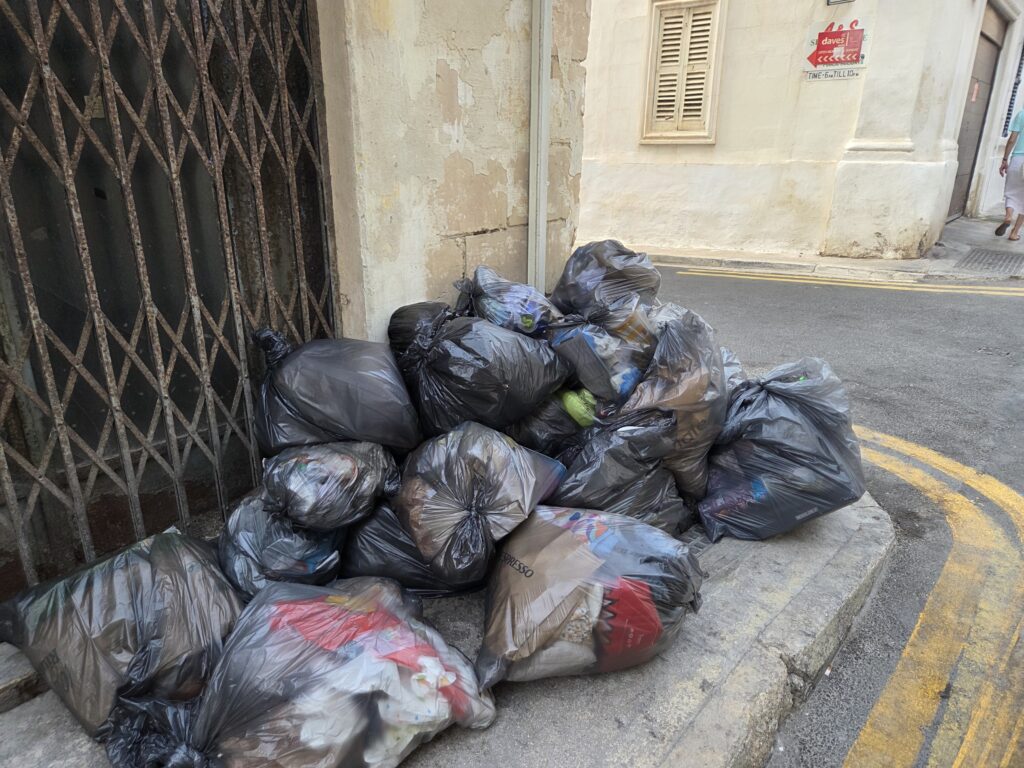
Waste is another highly visible pressure in several densely populated and tourism-heavy localities.
Malta’s rubbish problem cannot simply be blamed on tourists or short-lets. Residents, commercial establishments, collection arrangements, enforcement and incorrect disposal all contribute.
But the underlying mathematics cannot be ignored either.
Every additional person staying in Malta produces waste.
More visitors mean additional household refuse from tourist accommodation, restaurant waste, takeaway packaging, bottles and other material entering the waste collection system.
If Malta continuously expands tourism capacity, the services supporting that expansion must grow with it.
Otherwise, the cost of that growth eventually appears on somebody’s pavement.
Drainage problems and sewage reaching the sea
The issue becomes considerably more serious when pressure or failures involving Malta’s wastewater infrastructure result in sewage reaching bathing waters.
Malta has experienced temporary bathing prohibitions following sewage contamination.
One recent example occurred at Balluta Bay in June 2026.
Environmental Health authorities confirmed that foul water entering the bathing area was sewage. An investigation identified a blockage in the sewage network involving sizeable stone blocks and construction waste.
The bathing area was temporarily closed while the problem was addressed.
Source: Environmental Health Directorate – Balluta bathing prohibition report
It would therefore be incorrect to claim that tourism caused this particular sewage incident. The official investigation identified construction material blocking the sewer.
But the episode highlights a much broader point.
Malta’s carrying capacity is not determined by how many apartments and hotel rooms can physically be constructed.
It also depends on whether drainage, wastewater treatment and other infrastructure can reliably cope with the total population using them.
And then the electricity starts going off
July 2026 provided another warning about the pressure being placed on Malta’s infrastructure.
During the intense summer heatwave, power cuts affected numerous localities across Malta, including areas such as Sliema, St Julian’s, Swieqi, Qawra, Mellieħa, Qormi and others on different days.
On 21 July, electricity outages were reported across a long list of localities as faults developed in the distribution network.
The following day, Enemalta said electricity demand had reached a new record of 741 megawatts.
That significantly exceeded the previous peak of 663 MW recorded in 2023.
Enemalta said there was enough electricity generation available to meet demand and attributed the outages to faults in the distribution network rather than an overall shortage of generated electricity.
That distinction is important.
But for the carrying-capacity debate, the result is still significant: Malta experienced repeated electricity distribution failures at the same time as demand reached unprecedented levels.
Source: The Malta Independent – Enemalta reports record 741 MW demand, 22 July 2026
Source: MaltaToday – Enemalta attributes outages to separate network faults, 17 July 2026
Power cuts should be part of the tourism capacity discussion
Again, it would be misleading to claim that tourists caused Malta’s electricity outages.
Electricity consumption is affected by many factors, including population growth, air-conditioning use during extreme heat, commercial activity, construction, electric vehicles, businesses and household demand.
But tourists also consume electricity.
Hotels require air-conditioning, lifts, kitchens, pools, laundry facilities and other services. Short-let apartments require air-conditioning, water heating and household electricity just like residential properties.
If tens of thousands of tourists are present in Malta on an average summer night, they form part of the country’s effective population and therefore part of overall infrastructure demand.
That is why electricity cannot be separated from the carrying-capacity debate.
Malta reached record electricity demand while communities experienced power cuts
In July 2026, Malta reached a record electricity demand of 741 MW while several localities experienced electricity outages.
Enemalta said the country had sufficient generation capacity and that the outages resulted from distribution network faults.
But if Malta wants to continue increasing its resident population, tourist population and commercial activity, investment in the infrastructure carrying that demand has to keep pace.
An extra population of around 86,000 people
In June 2026 there were approximately 86,000 tourists staying in Malta on an average night, based on NSO guest-night statistics.
Those visitors understandably need many of the same basic services as residents:
- electricity;
- water;
- sewage and drainage infrastructure;
- waste collection;
- roads and public transport;
- beaches and public spaces;
- policing and enforcement;
- and emergency and public services.
Many leave the following day and are replaced by new arrivals, but the pressure on Malta does not disappear simply because those people are classified statistically as tourists rather than residents.
For infrastructure purposes, they are people physically present on the islands.
So, do we actually need more tourist accommodation?
Based on the available data, it is difficult to argue that Malta currently faces a general national shortage of tourist accommodation.
Short-lets alone provided more than 31,700 licensed beds by October 2025.
Hotels and other collective accommodation establishments provided more than 53,000 active bed places around the same period.
And even during the peak third quarter, collective accommodation averaged around 80% bed occupancy.
That does not mean Malta should prohibit every new hotel or short-let.
Markets change. Older accommodation closes. Different standards and types of accommodation may be required, and particular locations may experience genuine shortages.
But it does mean that approving additional accommodation should not happen automatically on the assumption that more tourist beds always equal progress.
Perhaps we are measuring the wrong thing
For decades, tourism success has largely been presented through figures such as arrivals, nights spent and expenditure.
Those figures are important.
But perhaps another set of indicators now deserves equal attention:
- How many tourist beds does Malta actually need?
- What percentage of existing accommodation remains available even during peak season?
- How many short-lets can residential neighbourhoods reasonably absorb?
- Can waste collection cope with continued population and visitor growth?
- Can the drainage and sewage network cope?
- Can the electricity distribution network cope with ever-higher peak demand?
- Can roads and public transport cope?
- How much pressure can beaches and public spaces take?
- And what is happening to the quality of life of the people who live here all year round?
The question Malta needs to answer
Not: “How many more tourists can we attract?”
But: “How many tourists can Malta comfortably accommodate without degrading residents’ quality of life, public infrastructure and the environment?”
Tourism needs limits as well as targets
Tourism remains one of Malta’s most important industries and millions of visitors enjoy the islands without creating any problems whatsoever.
This is therefore not an argument against tourists.
It is an argument for planning tourism according to Malta’s physical, environmental and social limits.
If Malta already has tens of thousands of licensed tourist beds, if collective accommodation is not operating at 100% capacity even during the summer peak, and if communities are simultaneously dealing with noise, rubbish, sewage incidents and electricity outages, then continuing to expand accommodation deserves much closer scrutiny.
Before approving thousands of additional tourist beds, Malta should be able to answer a simple question:
What problem are those additional beds actually intended to solve?
Because eventually the limiting factor will not be how many tourists Malta can physically fit into hotels and apartments.
It will be how much more pressure Malta’s communities, infrastructure and environment can realistically take.
“`