

Malta Should Be Asking Why
For many residents, 2026 has felt like the year short-lets started popping up like mushrooms across Malta.
Another apartment becomes tourist accommodation. Then another. Then another.
The people who actually live in the street remain there, but the neighbours around them change every few days. Suitcases roll through apartment blocks at all hours. Rubbish is put out on the wrong days. Groups arrive late at night. Noise complaints become routine. Common areas designed for residents become part of a revolving-door tourism business.
And at the same time, ordinary people are struggling to find somewhere affordable to live. Barcelona has looked at this problem and decided that there has to be a limit. Malta should be paying very close attention.
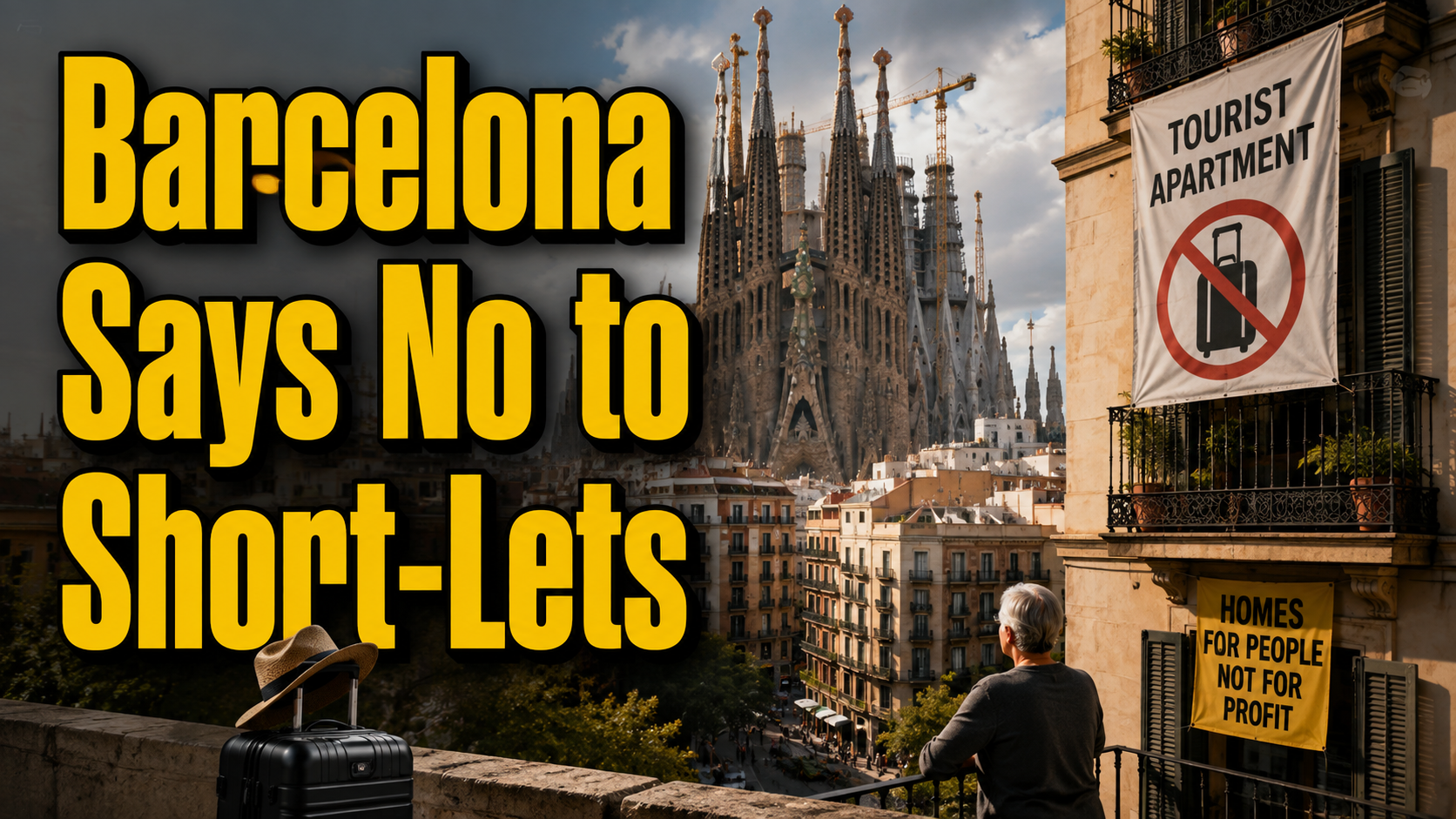
 Barcelona has had enough of short-lets. Should Malta be paying attention?
Barcelona plans to phase out 10,101 licensed tourist apartments by 2028 because of the pressure on housing and residential communities.
Now compare the numbers:
- Barcelona
 Population: 1.73 million
 Licensed tourist apartments: 10,101
 Around 1 short-let for every 171 residents
 Malta & Gozo
- Population: 588,254
- Licensed short-lets: close to 8,000
- Around 1 short-let for every 74 residents
That means Malta has roughly 2.3 TIMES as many licensed short-lets per head of population as Barcelona.
And Barcelona has decided its level is already too much.
Meanwhile in Malta, short-lets have been popping up like mushrooms, particularly in already heavily affected communities, while many workers are earning around €1,400–€1,600 gross a month and struggling with the cost of housing.
Tourism is important. But surely there has to be a balance. If Barcelona considers 10,101 tourist apartments too many for 1.73 million residents, what should we be saying about almost 8,000 for just 588,000 people?
How many more homes can Malta afford to lose?
Barcelona is choosing homes over holiday apartments
Barcelona plans to stop renewing the licences of 10,101 tourist apartments by November 2028, effectively removing licensed short-term tourist apartments from the city and potentially returning thousands of properties to residential use.
This is not some minor restriction. It is one of Europe’s strongest responses to the impact of short-term tourist accommodation on housing and residential communities.
Barcelona’s mayor, Jaume Collboni, has pointed to an extraordinary rise in housing costs. When announcing the measure, he said rents in Barcelona had increased by 68% over the previous decade, while the cost of buying a home had risen by 38%.
The reasoning is simple. When thousands of apartments are more profitable as holiday accommodation than as homes for residents, those properties are removed from the normal residential market.
Barcelona has decided that this cannot continue indefinitely. And importantly, the policy survived a major legal challenge. In March 2025, Spain’s Constitutional Court rejected an appeal against the Catalan framework supporting restrictions on tourist apartments. Barcelona subsequently reiterated that it would not renew the licences after 2028.
Barcelona is not banning tourism. Hotels will still operate. Tourists will still visit. Restaurants, attractions and businesses will still benefit from visitors.
What Barcelona is challenging is the idea that every residential apartment must also be available to the tourism industry. That is a distinction Malta desperately needs to understand.
Malta’s “average wage” does not tell the real story
Whenever housing affordability is discussed in Malta, someone inevitably produces an average salary figure and suggests things are not as bad as people claim.
According to the National Statistics Office, the average monthly basic salary in Malta during the first quarter of 2026 was €2,270.
But look deeper into the same statistics. Workers in elementary occupations earned an average basic salary of just €1,410 per month, while managers averaged €3,628.
That difference matters enormously. An average can be mathematically correct while still being completely unrepresentative of what a large section of the population sees in its bank account every month.
There are people going to work every day earning around €1,400 to €1,600 gross per month.
Before tax.
Before National Insurance.
Before food.
Before electricity and water.
Before transport.
And before paying rent.
So whether Malta technically has the highest, fifth-highest or tenth-highest rents in Europe misses the real issue.
What matters is the relationship between wages and the cost of putting a roof over your head.
For somebody earning €1,500 gross, even a rent approaching €900 or €1,000 represents an enormous part of their income before they have bought a single bag of groceries.
That is the reality that average salary statistics can hide.
Meanwhile, almost 8,000 homes are licensed as short-lets
Malta and Gozo now have almost 8,000 properties licensed as short-let accommodation.
Just think about that number for a moment. Almost 8,000 properties. In one of the smallest and most densely populated countries in Europe. Of course, short-lets are not solely responsible for Malta’s housing problems.
Population growth, speculative investment, planning policy, construction costs, overseas demand, vacant properties and the country’s limited land supply all contribute.
But pretending short-lets have no impact on housing supply would be equally ridiculous. An apartment cannot simultaneously be occupied by tourists for three nights and rented to a local family for three years.
When a residential property is converted into permanent tourist accommodation, that is one less property potentially available to the normal rental market.
Multiply that by hundreds. Then thousands. Then concentrate those properties in places such as Sliema, Gżira, St Julian’s, Swieqi and St Paul’s Bay.
At some point the question has to be asked: How many is too many?
Residents are paying a second price: quality of life
Housing affordability is only half the story. Residents are also being asked to absorb the social consequences of turning residential buildings into unofficial hotels.
- A proper hotel has reception staff.
- It has management.
- It has designated tourist facilities.
- It has systems for dealing with guests, cleaning, rubbish and complaints.
A short-let can place a constantly changing group of tourists directly beside somebody’s bedroom, above an elderly resident, below a family with children or inside a block whose owners bought their properties believing they were buying into a residential building.
That is a fundamentally different situation. Most tourists behave perfectly well. The problem is the minority who do not, combined with a system that can allow the consequences to fall almost entirely on neighbours.
- Who deals with the screaming at 3am?
- Who deals with rubbish left outside on the wrong day?
- Who deals with overcrowding?
- Who calls the police?
- Who calls the MTA?
- Who repeatedly reports the same property?
Usually, it is the resident. The tourism operator takes the booking. The neighbourhood absorbs the consequences.
Malta has tightened the rules, but there is a massive loophole
Malta introduced stronger short-let regulations in June 2026. Among the new requirements are a waste-management plan, a named person available 24 hours a day to deal with complaints, licence information displayed outside the property and limits generally restricting accommodation to two people per bedroom and ten people per unit. Licences may also be suspended or revoked for confirmed breaches relating to noise, waste or public health.
These measures are welcome. But there is a major problem. Many properties that already had short-let licences before the new rules came into force are exempt from several of the new restrictions, including the new occupancy limits. The MTA said existing licence holders retain certain acquired rights when they renew.
So Malta has tightened the rules while effectively grandfathering a huge part of the existing industry.
Barcelona has gone in the opposite direction. Barcelona is saying that the existence of a licence today does not necessarily mean that licence must exist forever. That may be the most important lesson Malta can learn.
A short-let licence should not be a lifetime entitlement
Why should permission to operate tourist accommodation inside a residential community automatically become an acquired right forever?
- Circumstances change.
- Neighbourhoods change.
- Housing needs change.
- Tourism pressure changes.
If an area becomes saturated with tourist accommodation, government should be able to say:
Enough. No more licences here. And when licences come up for renewal, the impact on the surrounding community should matter.
A licence should be permission to operate subject to conditions. It should not become a permanent entitlement for the property regardless of what happens around it.
Malta does not have to copy Barcelona. But it should copy its courage.
A complete Barcelona-style phase-out may or may not be the right answer for Malta. There are legitimate short-let businesses. There are tourism areas where holiday accommodation makes sense. Farmhouses, villas and properties specifically designed for visitors are not necessarily comparable to apartments scattered through residential blocks.
But Malta urgently needs a more intelligent system.
1. Cap short-lets by locality
There should be a maximum concentration of short-let accommodation within individual localities and neighbourhoods.
Once that threshold is reached, applications for new licences should stop. Sliema does not need an unlimited number of tourist apartments simply because another landlord wants one.
2. Look at individual streets, not just national numbers
Even locality-wide statistics may hide the problem. One street can have a completely different experience from another. If one residential road already contains dozens of tourist properties, approving another ten should require serious justification.
3. Give apartment-block residents a meaningful voice
Converting an apartment into intensive tourist accommodation affects more than the owner of that apartment.
- It affects the entrance.
- The lift.
- The stairwell.
- The rubbish area.
- The security of the building.
- And the people sleeping on the other side of the wall.
Owners and residents in condominium blocks should have a meaningful say before another unit is converted into tourist accommodation.
4. Make renewal dependent on behaviour
Repeated substantiated complaints about noise, overcrowding, rubbish or public nuisance should matter when a licence comes up for renewal. A property that continually creates problems should not simply receive another licence as though nothing happened.
5. Publish enforcement figures
Malta needs transparency.
- How many short-lets were inspected?
- How many were found in breach?
- How many were fined?
- How many licences were suspended?
- How many were revoked?
Residents should not have to rely on occasional headlines to discover whether the system is actually being enforced. Recent inspections in Swieqi demonstrate why this matters. Authorities inspected 252 short-let properties and found that more than a quarter had at least one violation. That should concern everyone.
6. Study the impact on housing before issuing more licences
Before expanding the short-let market any further, government should publish proper locality-by-locality data showing how much residential housing has moved into tourist accommodation.
Can the people who work in these areas still afford to live in them?
Tourism cannot be allowed to consume the country it depends on
Malta needs tourism. Nobody serious is suggesting otherwise. Tourism supports thousands of jobs and businesses. But tourism is supposed to contribute to the country.
The country does not exist solely to accommodate tourism. There is a point where economic growth begins to carry unacceptable social costs.
There is a point where residents should not have to compete with tourists for ordinary apartments. There is a point where workers earning around €1,500 a month cannot simply be told that the market has decided they should spend most of their income on housing.
There is a point where a residential building stops being residential because half the doors have become holiday accommodation. And there is a point where government has to say enough.
Barcelona reached that point. Malta should not wait until entire communities have been hollowed out before admitting that we have a problem.
Barcelona looked at more than 10,000 tourist apartments and asked whether those properties could serve its residents better as homes.
Malta already has almost 8,000 licensed short-lets. For a country our size, that should trigger a serious national conversation.
How many more homes can Malta afford to lose?
Tourists are welcome. Tourism is important. But residents should not have to surrender their housing, their sleep, their streets and their communities to sustain it.
Malta must remain a country where people can live, not simply a destination where everyone else can stay.