
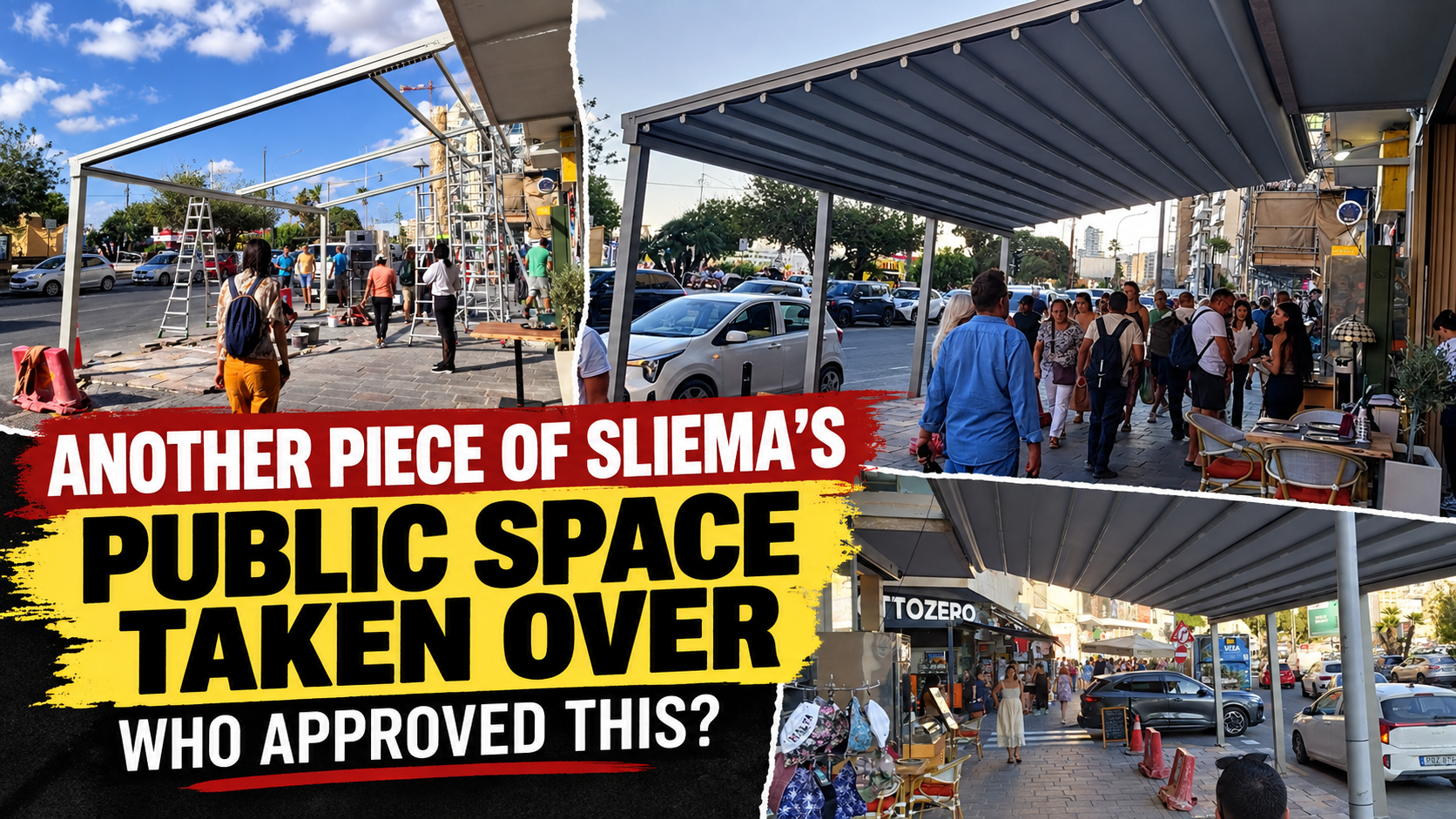

Another sizeable structure has appeared on The Strand in Sliema, this time outside the Carlo Stivala development at the corner of Triq il-Lunzjata.
And residents are asking a very simple question:
Who approved this?
The structure extends over a substantial part of the pavement immediately beside a busy junction.
This is not some quiet side street.
Cars exiting Triq il-Lunzjata have to join The Strand, one of the busiest roads in the area. Drivers need a clear view of traffic approaching from the Gżira direction before they can safely pull out.
Now there is a large structure sitting right beside that junction.
To make matters worse, there is also a bus stop almost immediately after the turn. When a bus stops there, drivers exiting the side street can already find their visibility restricted and may have to edge further into The Strand before they can see clearly.
So was the effect on visibility actually assessed before this structure was allowed?
We Found the Hotel Permit — But What Permit Covers This Structure?
Malta Gone Wild checked the publicly available planning records for the site.
The development is covered by PA/03229/23, concerning 4 and 5 Triq il-Lunzjata, corner with 20 and 21 Ix-Xatt, Sliema.
The application was granted in 2025 and describes the sanctioning of a Class 3B hotel, including a Class 4D restaurant at ground-floor level and 79 guest rooms above. :chatgpt-content-reference{index=”0″}
What we have not been able to identify in the publicly searchable records is a separate permit that specifically describes the large pavement structure now visible outside the development as a canopy, pergola, platform or similar structure.
That does not automatically mean that no authorisation exists.
But if there is a separate permit or encroachment authorisation covering it, then the public should be able to know exactly what was approved and by which authority.
How Much More Public Pavement Are We Expected to Give Up?
There is also a wider issue here.
How much more public pavement are we expected to surrender to private commercial development?
These pavements belong to everyone: residents, elderly people, parents with pushchairs, wheelchair users, commuters and thousands of pedestrians walking along the Sliema front every day.
They are not simply spare extensions of hotels and restaurants.
If the area underneath this structure is subsequently occupied by tables, chairs or other commercial furniture, the amount of usable pedestrian space could be reduced further.
The Development Has Already Attracted Controversy
The site has already been the subject of considerable controversy.
Before PA/03229/23 was approved, concerns were raised that construction had progressed beyond the height permitted under earlier approvals. Developer Carlo Stivala disputed claims that the building had exceeded its authorised height. :chatgpt-content-reference{index=”1″}
The application itself included the sanctioning of the hotel development and was eventually granted by the Planning Authority in 2025. :chatgpt-content-reference{index=”2″}
Safety concerns were also raised during construction after a concrete bucket was reported hanging above Triq il-Lunzjata while vehicles and pedestrians continued underneath it. :chatgpt-content-reference{index=”3″}
The approved hotel permit was subsequently challenged through appeal PAB/00141/25, filed by Din l-Art Ħelwa and others. The appeal appeared on the Environment and Planning Review Tribunal’s decision agenda for January 2026. :chatgpt-content-reference{index=”4″}
These Questions Need Answers
This new pavement structure deserves proper scrutiny.
- What permit specifically authorises this structure over the pavement?
- Is it covered by PA/03229/23 or by a separate approval?
- Has an encroachment permit been issued for the public land beneath it?
- How much public pavement has been allocated to the premises?
- Was Transport Malta consulted about visibility for vehicles exiting Triq il-Lunzjata?
- Was pedestrian flow and accessibility assessed?
- Will tables and chairs be placed underneath the structure?
- What minimum unobstructed pavement width must remain available to pedestrians?
Perhaps every permit is in order.
If so, show us the permit.
The public should not have to watch another large commercial structure appear over a Sliema pavement without being able to establish who authorised it, what exactly was approved and whether road safety and pedestrian access were properly assessed.
Sliema has already surrendered a considerable amount of its streets and pavements to construction and commercial activity.
Public pavement is public space — and the public deserves to know who is allowing it to be used.