
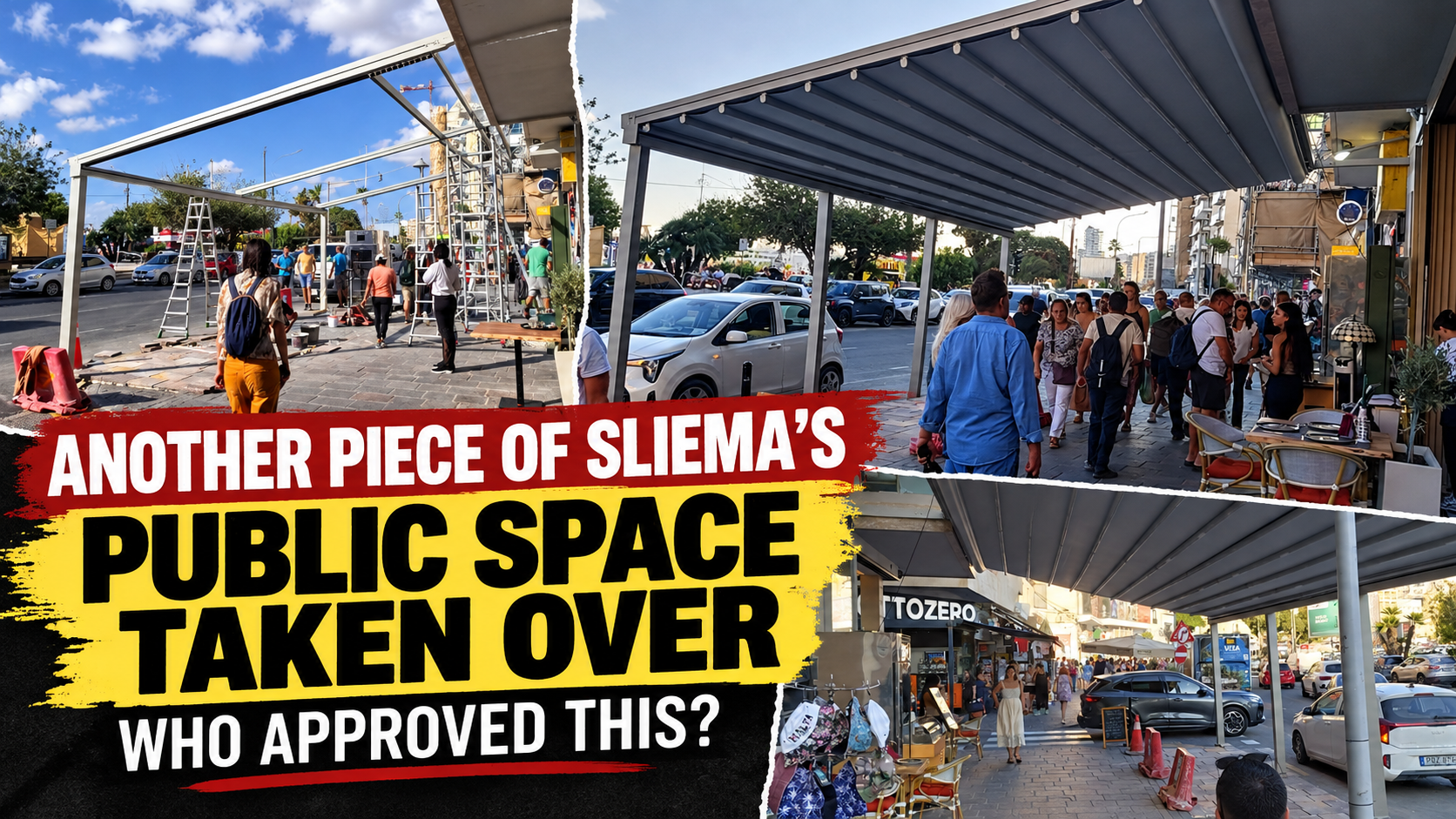

The controversial canopy outside Piccolo Padre on The Strand is now being dismantled.
A photograph sent to Malta Gone Wild today shows workers taking apart the metal structure outside the restaurant at the Centric Hotel, just days after the Planning Authority issued enforcement notice EC/00122/26 ordering the removal of the unauthorised development.
This is a positive result — and an important reminder that public space can be defended when residents, organisations and local authorities refuse to simply accept its takeover.
The structure had spread across the pavement and towards the carriageway at one of Sliema’s busiest junctions, prompting concerns over pedestrian access, road safety and the use of public land for private commercial purposes.
Residents raised the alarm. The Sliema Local Council intervened. Civil society organisations spoke out. The Planning Authority eventually issued an enforcement notice.
And now the canopy is coming down.
But there is still a question worth asking: why should an unauthorised structure occupying public space ever have been allowed to reach this stage in the first place?
Public space belongs to the public. Protecting it should be the norm — not something that only happens after complaints, pressure and public outrage.
UPDATE – 2 October 2026: The Planning Authority has now ordered the removal of the structure highlighted by Malta Gone Wild on The Strand in Sliema.
The structure, erected outside the new Piccolo Padre restaurant at the Centric Hotel at the corner of Triq il-Lunzjata and Ix-Xatt, is now the subject of Planning Authority enforcement notice EC/00122/26.
And the PA’s position is clear: the development is unauthorised.
PA Orders the Structure Removed
The Planning Authority has issued enforcement notice EC/00122/26 covering the site at 4 and 5 Triq il-Lunzjata, corner with 20 and 21 Ix-Xatt, Sliema.
The enforcement case concerns several elements of the development outside the restaurant, including:
- A retractable awning projecting across the pavement and partly over the carriageway;
- A supporting pillar positioned within the road area;
- Tiles laid over part of the road beneath the structure; and
- Planters positioned around its perimeter.
The enforcement notice identifies developer Carlo Stivala as the contravener. The chairperson of the Lands Authority is also listed in the case because the works involve public land.
The Planning Authority said it received a number of complaints while the structure was being erected, including representations from the Sliema Local Council.
Those complaints raised precisely the issues highlighted when Malta Gone Wild first published this article: public space, pedestrian accessibility and road safety.
The PA says instructions had already been given to stop works on site. The enforcement notice has now followed, with the authority warning that further enforcement action may be taken if those responsible fail to comply without delay.
So, Who Approved This?
When Malta Gone Wild first photographed the structure, our question was simple:
Who approved this?
We checked the publicly available planning records for the property.
The hotel development itself is covered by PA/03229/23, concerning 4 and 5 Triq il-Lunzjata, corner with 20 and 21 Ix-Xatt.
But we could not identify a planning permit specifically authorising the large structure extending over the pavement and towards the road.
We wrote at the time that this did not necessarily prove that no authorisation existed and invited the relevant authorities to clarify what had been approved.
We now have that clarification.
The Planning Authority has classified the structure and associated works as unauthorised development and has ordered their removal.
A Busy Junction — Not a Quiet Side Street
The location makes the issue particularly significant.
The structure sits immediately beside the junction where vehicles exiting Triq il-Lunzjata join The Strand, one of Sliema’s busiest roads.
Drivers leaving the side street need visibility of traffic approaching along the seafront before pulling out.
There is also a bus stop almost immediately beyond the junction, meaning visibility can already become restricted when a bus is stopped there.
Placing a substantial commercial structure beside such a junction therefore raised legitimate questions about road safety and sightlines from the moment it appeared.
Sliema Local Council Also Called for Enforcement
The Sliema Local Council subsequently called for immediate enforcement action.
Lawyer Claire Bonello, acting on behalf of the council, raised concerns with the Planning Authority’s Enforcement Directorate over the large metal-framed structure occupying the public pavement and extending towards the carriageway.
The council also raised concerns about accessibility for wheelchair users and visually impaired pedestrians, pedestrian movement and the structure’s proximity to passing traffic.
A check of the Planning Authority’s MapServer carried out on 1 October had reportedly failed to identify a planning application specifically covering the structure.
Residents Had Raised the Alarm
The Sliema Residents Association also demanded urgent intervention, saying that the awning appeared to occupy the width of the pavement while paving works extended into the road.
The association raised concerns about the continuing loss of public space to private commercial activity and the potential obstruction created for pedestrians and motorists.
Moviment Graffitti also became involved, demanding that commercial activity beneath the structure stop and calling for its removal.
Public Pavement Is Not Spare Commercial Space
This case raises a wider issue that goes far beyond one restaurant or one development.
How much of Malta’s public pavement are residents expected to surrender to private commercial activity?
Pavements are used by everyone: elderly residents, parents with pushchairs, wheelchair users, commuters, tourists and thousands of people walking through Sliema every day.
They are not simply spare extensions of hotels, restaurants and bars.
Sliema in particular has seen increasing pressure on its pavements from construction sites, tables and chairs, advertising boards, platforms, structures and other commercial uses.
In this case, the concern was raised while the structure was still being built.
Residents complained.
The Local Council complained.
Civil society groups complained.
And the Planning Authority has now issued an enforcement notice ordering the unauthorised development to be removed.
Public pavement is public space. It should not take public outrage before authorities step in to protect it.
What Happens Next?
The important question now is whether the enforcement notice will actually be complied with — and how quickly.
The PA has stated that if those responsible fail to comply without delay, it will take the necessary enforcement action within its remit.
Malta Gone Wild will continue following the case and will update this article if the structure is removed, altered or if any further planning application is submitted covering the works.
Enforcement reference: EC/00122/26
Planning application for the hotel development: PA/03229/23
Additional reporting: MaltaToday – PA orders removal of illegal Piccolo Padre structure on Strand Street.