

No Agreement with Lands Authority, Tribunal Hears
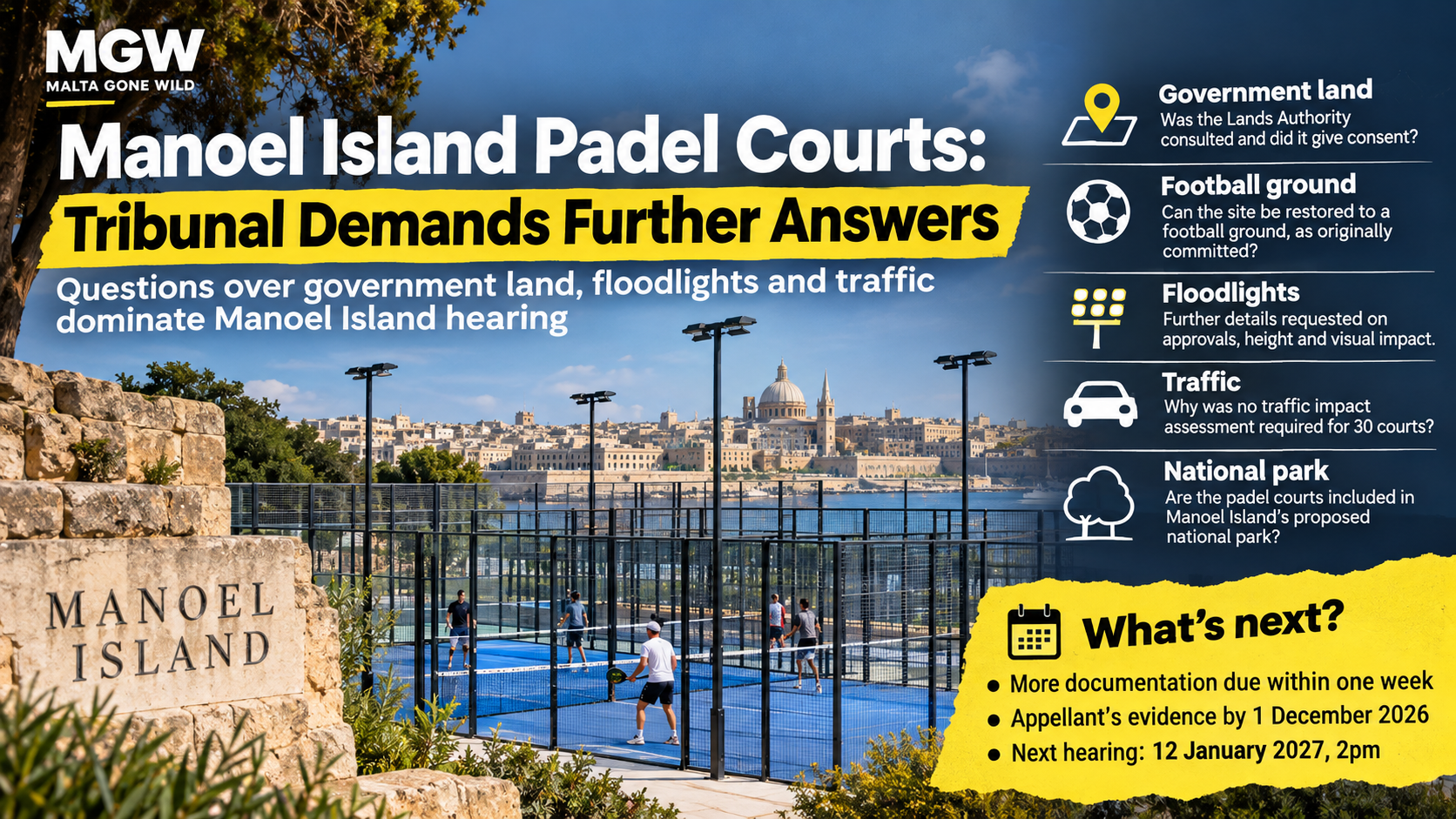
Questions over government land, planning approvals, traffic and the future of the former Nicholl football ground emerged during an Environment and Planning Review Tribunal hearing.
Fresh questions have emerged over the controversial padel courts at Manoel Island after the Lands Authority’s Chief Executive Officer, Robert Vella, testified that Gżira United FC has no current agreement with the authority for the land occupied by the padel complex.
The testimony was given during a hearing before the Environment and Planning Review Tribunal (EPRT) on 10 November 2026, as part of Appeal 264/26 challenging the Planning Authority’s decision to sanction 20 previously unauthorised padel courts and approve another 10.
The appeal was filed by environmental and civil society organisations Flimkien għal Ambjent Aħjar, Moviment Graffitti and Żminijietna.
Original land concession terminated in 1993
During questioning, Vella explained that the original land concession granted to Gżira United in 1976 had been terminated in 1993, when plans for the wider Manoel Island development were being prepared.
His testimony differed from that of architect Ruben Sciortino, who maintained that the original agreement had become applicable again following the termination of the MIDI concession.
Vella also confirmed that the land occupied by the former Nicholl Ground, the clubhouse and the padel courts was at least partly government-owned.
However, he could not immediately confirm whether the Lands Authority had been consulted about the padel court development or whether it had granted its consent.
The Tribunal subsequently requested written clarification on these points, including whether Gżira United had sought permission to sublet all or part of the site.
These questions are particularly significant given the commercial use of land historically associated with a football ground.
Can the site really be restored to a football ground?
Another important issue concerned the description of the padel courts as demountable structures.
Architect Ruben Sciortino maintained that the padel courts qualified as sports facilities and that their structures could be dismantled.
When questioned about how long this would take, he estimated approximately two days.
However, he was unable to provide an estimate of the cost of restoring the original football ground and confirmed that assessing the feasibility and viability of such a restoration had not formed part of his work.
The distinction between a football ground and a general sports facility was repeatedly raised during the hearing.
When questioned about the longstanding commitment to provide Gżira United with a replacement sports ground, Lands Authority CEO Robert Vella specifically identified the commitment as relating to a football ground.
This raises an important question about whether the construction of padel courts satisfies the original sporting commitments associated with the site.
No traffic impact assessment for 30 padel courts
The hearing also examined whether the potential traffic generated by the development had been adequately assessed.
Transport Malta representative Neil Portelli confirmed that the authority had been consulted twice about the development.
During questioning, it was pointed out that 30 padel courts could accommodate between 60 and 120 players simultaneously, depending on whether singles or doubles matches were taking place.
This estimate did not include coaches, employees or spectators.
Despite the potential number of users, Portelli explained that no separate Traffic Impact Assessment had been required.
According to his testimony, the Planning Authority’s assessment indicated that additional transport studies were unnecessary and that parking requirements could be considered under existing planning policies.
The implications for traffic and parking in the surrounding area remain a matter of public concern.
Questions over floodlights and planning approvals
The Tribunal also heard questions concerning the floodlights installed at the padel complex.
The appellant’s lawyer sought clarification about their approval, height, foundations and potential visual impact.
Further questions concerned the materials used in the development and whether the structures could genuinely be removed without substantial works.
The architect was instructed to provide additional documentation, including information about the floodlights, their foundations, the dismantling process and archaeological supervision.
What about Manoel Island’s promised national park?
The hearing also touched on the government’s plans to transform Manoel Island into a national park.
Vella explained that following the revision of the MIDI concession in 2026, the government had regained control of substantial parts of Manoel Island.
However, when questioned about whether the privately operated padel courts formed part of the proposed national park, he did not confirm their inclusion.
He explained that decisions about the future use of government land remained subject to the relevant government processes.
The future of the former Nicholl Ground therefore remains an important issue in the wider discussion about how Manoel Island should be used.
Tribunal orders further documentation
At the conclusion of the hearing, the Tribunal directed architect Ruben Sciortino to provide additional information concerning the planning approvals, floodlights, foundations, visual impact and dismantling of the padel structures.
Lands Authority CEO Robert Vella was also instructed to clarify whether the authority had been consulted, whether its consent had been obtained, and whether permission to sublet the land had ever been requested.
Both witnesses were asked to provide the relevant information within one week of the hearing.
The appellant was given until 1 December 2026 to conclude its documentary evidence.
The next hearing is scheduled for 12 January 2027 at 2pm.
The future of Manoel Island
The developments come amid growing scrutiny of how Manoel Island will be managed following the government’s decision to reclaim the site from MIDI.
While the Planning Authority has sanctioned the existing padel courts and approved additional courts, the decision remains under appeal.
The Tribunal has not ruled that the development is unlawful, and the proceedings remain ongoing.
Nevertheless, the hearing has highlighted several unresolved questions about landowner consent, historic sporting commitments, planning assessments and the future use of an area intended to form part of one of Malta’s most significant public spaces.
For the communities surrounding Manoel Island, the central question remains whether the future development of the site will reflect the public commitments made about its use.
Source: Environment and Planning Review Tribunal, Appeal 264/26, minutes of the sitting held on 10 November 2026. Additional reporting: Times of Malta, 17 November 2026.