
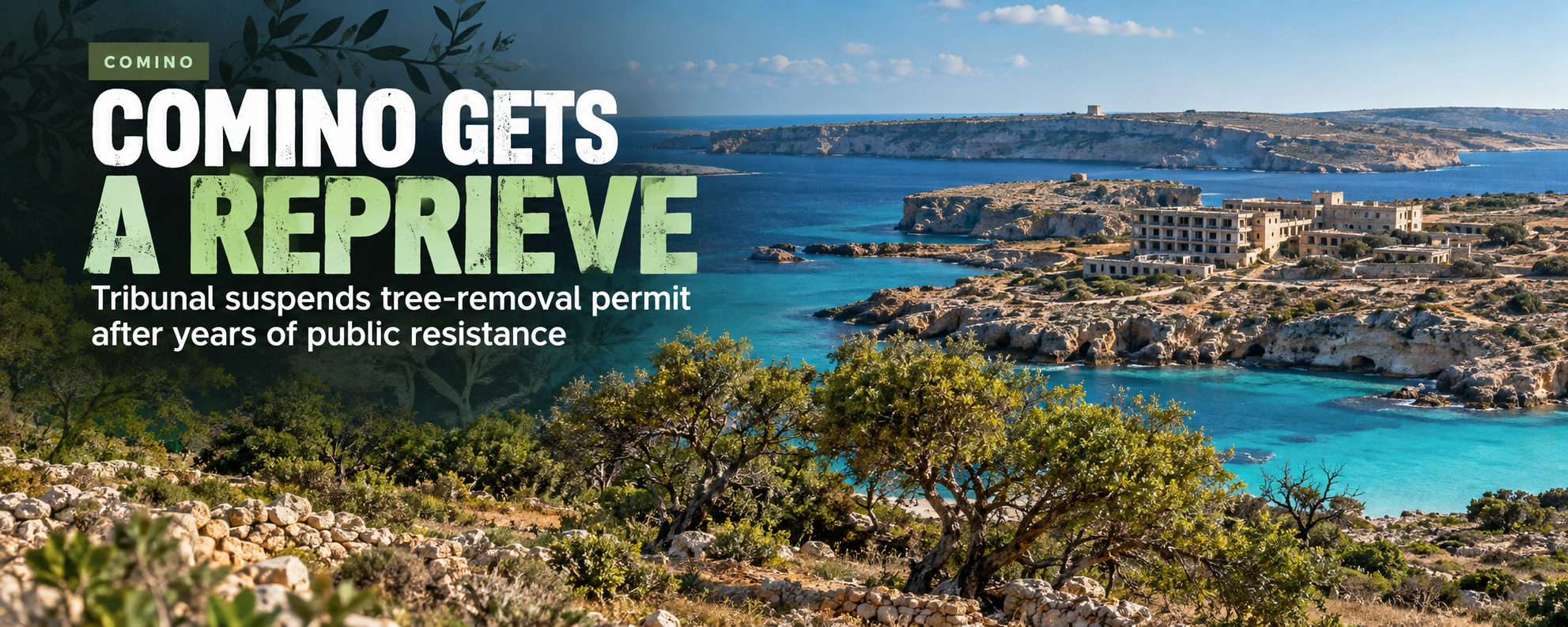

Comino has been given an important — if temporary — reprieve.
The Environment and Planning Review Tribunal (EPRT) has suspended the environmental permit that would have allowed preparatory works for the proposed Six Senses Comino development, including the removal and transplantation of hundreds of trees and shrubs.
The suspension means those works cannot proceed while the tribunal considers an appeal against the permit.
For Malta Gone Wild, however, the bigger story is not simply the tribunal decision.
It is how much persistence was required to get here.
The development has not been cancelled, but preparatory environmental works are on hold while the appeal process continues.
Years of resistance, objections and legal challenges
Opposition to the redevelopment of the Comino Hotel and bungalow sites has been building for years.
Environmental organisations, activists and members of the public have repeatedly questioned whether a development of this scale should proceed on one of Malta’s most sensitive and recognisable islands before all planning and environmental disputes have been fully resolved.
The approved project involves a 71-room hotel and 16 detached bungalows at the sites of the existing hotel complex at San Niklaw and the bungalow area at Santa Marija.
The plans have faced sustained resistance from environmental organisations and thousands of members of the public.
More than 13,000 objections
One of the clearest signs of public concern came during the planning process, when more than 13,000 objections were lodged against the proposal.
That is not a handful of activists making noise.
It represents one of the largest organised waves of public opposition seen against a development project in Malta in recent years.
Hundreds of people later also donated money to help environmental organisations pursue legal appeals against the project.
The organisations that refused to give up
A coalition of environmental and heritage organisations has challenged decisions connected with the Comino development.
Those organisations include:
- Azzjoni: Tuna Artna Lura
- BirdLife Malta
- Din l-Art Ħelwa
- Friends of the Earth Malta
- Għawdix
- Moviment Graffitti
- Nature Trust – FEE Malta
- Ramblers Association of Malta
- The Archaeological Society Malta
- Wirt Għawdex
Individual objectors and activists have also joined the legal challenges.
These groups deserve recognition not simply for issuing statements or organising protests, but for doing the much less glamorous work that environmental battles increasingly require.
Studying permits. Filing objections. Raising legal funds. Appearing before tribunals. Challenging procedures. Going to court. And continuing when the process drags on for months or years.
The public helped fund the fight
After the Planning Authority approved the project, environmental groups launched the Together for Comino crowdfunding campaign to finance an appeal.
The target was €20,000.
Hundreds of people contributed.
The campaign eventually raised the money needed to pursue the legal challenge.
That matters.
Because people did not simply post angry comments on social media and move on.
They put their own money behind the fight.
A major court victory followed
In May 2026, the Court of Appeal annulled an earlier EPRT decision connected with the Comino development and sent the case back to the tribunal for reconsideration.
The court ruling did not itself permanently cancel the underlying development permit.
But it meant that important aspects of the case had to be reconsidered.
For environmental campaigners, this represented a significant legal victory after years of opposition.
Then came the battle over the trees
The Environment and Resources Authority later granted an environmental permit allowing interventions involving hundreds of trees and shrubs, together with preparatory methods associated with excavation, demolition and construction.
The figures surrounding the trees have been the subject of considerable debate.
ERA stated that the approved works included:
- the removal of hundreds of non-protected specimens;
- the removal of a smaller number of protected trees;
- the transplantation of hundreds of additional trees and shrubs;
- and compensatory planting requirements.
The developer has argued that descriptions suggesting hundreds of protected trees would simply be destroyed misrepresent the permit and has said the redevelopment would involve extensive landscaping and new planting.
But the environmental groups’ objection has always gone beyond a simple numbers game.
The central question is much more basic:
The permit had already been challenged once
This was not the first time environmental campaigners challenged the environmental permitting process.
An earlier version of the permit was revoked after an appeal by Moviment Graffitti, following concerns over the procedure used and the opportunity for public participation.
ERA subsequently reconsidered the application and issued another permit.
That triggered another appeal.
And now the tribunal has suspended the permit while that appeal is heard.
Moviment Graffitti kept Comino firmly in the spotlight
Moviment Graffitti has played a particularly visible role in keeping the issue alive.
When the latest environmental permit was issued, the organisation launched another crowdfunding initiative to help finance the appeal.
It also launched Comino Watch, encouraging people visiting or passing the island to report signs of heavy machinery, excavation, demolition, construction activity or tree removal.
Whatever one’s view of the final development proposal, this is what sustained civic scrutiny looks like.
Follow the permit. Read the paperwork. Appeal the decision. Raise the money. Watch the site. Keep the public informed.
Students and other organisations joined the call
The resistance has also spread beyond the original environmental organisations.
Student organisations and other civil society groups have publicly argued that Comino deserves the highest possible environmental protection and questioned whether works should proceed while the wider development remains contested.
This builds on years of campaigning around Comino, including public actions concerning the commercial occupation of the Blue Lagoon and the wider question of how much pressure the tiny island should be expected to absorb.
What has actually been stopped?
For the moment, the environmental works covered by the disputed permit are suspended.
This includes interventions involving the removal and transplantation of trees and shrubs connected with the preparatory phase of the redevelopment.
The suspension remains in place while the appeal is considered.
The developer, HV Hospitality, has said it accepts the tribunal process and has argued that certain transplanting works are seasonally sensitive, with winter being considered more suitable for plant survival.
It is therefore important to be precise:
The tribunal has suspended the environmental permit while the appeal is being heard. The legal battle continues.
Why Comino matters
Comino is not an ordinary development site.
The island forms part of a highly sensitive landscape protected through environmental designations, including Natura 2000 protections.
Its small size, ecological importance, visual character and already intense seasonal tourism pressure make any major development particularly controversial.
The environmental organisations challenging the project argue that those protections must mean something in practice — not merely exist as labels on maps while substantial works proceed before legal disputes are resolved.
The tribunal has not yet decided whether those arguments will ultimately succeed.
But the suspension ensures that, at least for now, the physical landscape will not race ahead of the legal process.
Credit where credit is due
Environmental victories rarely happen because somebody writes one angry Facebook post.
They happen because people keep going long after everyone else has stopped paying attention.
The organisations opposing the Comino development have objected, fundraised, appealed, gone to court, challenged administrative procedures and returned to tribunals repeatedly.
The public backed them with thousands of objections and hundreds of individual donations.
That deserves recognition.
Today is not the time for victory laps.
The development has not disappeared.
The appeals remain unresolved.
And the developer continues to maintain that the project represents a lower-density, environmentally sensitive redevelopment of an existing tourism complex.
But neither should this moment be dismissed.
For now, Comino gets to wait.
And that almost certainly would not have happened without the persistence of environmental organisations, activists, objectors and ordinary members of the public who refused to let the issue quietly disappear.
Sometimes protecting a place means refusing to give up on it
Credit must go to Moviment Graffitti, Azzjoni: Tuna Artna Lura, BirdLife Malta, Din l-Art Ħelwa, Friends of the Earth Malta, Għawdix, Nature Trust – FEE Malta, Ramblers Association of Malta, The Archaeological Society Malta, Wirt Għawdex, the individual appellants, student groups and everyone who donated, objected or helped keep public attention on Comino.
They have not won the entire battle.
But they have achieved something extremely important.
They have bought Comino time.
And sometimes, when development pressure is moving faster than the legal system, time is exactly what nature needs.