
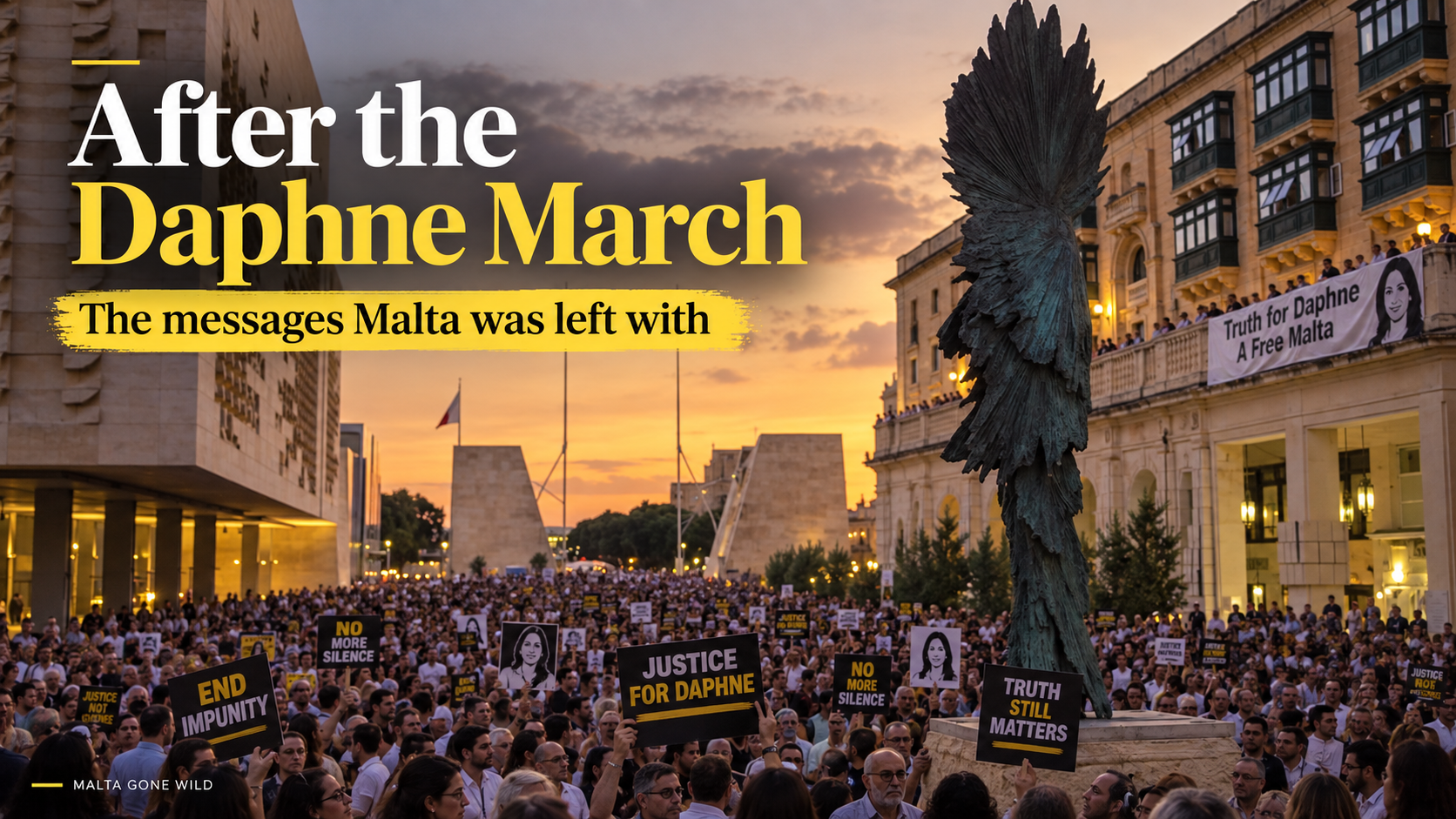

Thousands walked through Valletta on Wednesday demanding justice, accountability and an end to impunity.
But when the march ended and the crowds began to leave, the story did not end with the numbers in the streets.
What remained were the messages.
From Daphne Caruana Galizia’s father and nieces, to her son Matthew, civil society groups including Moviment Graffitti, political leaders and senior European figures, the days surrounding the demonstration have produced a wider conversation about justice, institutions and what happens next.
The trial may have ended, but demands for accountability, institutional reform, press freedom and implementation of the Daphne Caruana Galizia public inquiry recommendations have not.
A grandfather remembers an ordinary afternoon
One of the most personal moments of Wednesday’s gathering came from Michael Vella, Daphne Caruana Galizia’s father.
His message was read to the crowd by his granddaughter, Megan Mallia.
Vella recalled sitting with his late wife Rose in Daphne’s garden shortly before her assassination. Their grandchildren were picking olives and the family dogs were playing nearby.
It was an entirely ordinary family afternoon.
But across the valley, he recalled, the men who would later murder his daughter were watching.
“Paid hitmen watched – and waited.”
A few days later, Daphne Caruana Galizia was killed by a bomb placed in her car.
Vella’s message did not frame the struggle solely around his daughter.
He told those gathered that the battle was also about sound institutions, the rule of law and the type of country Malta chooses to be.
Source: Times of Malta, 17 September 2026
Amy and Megan Mallia: think for yourselves
Daphne’s nieces Amy and Megan Mallia brought another theme into the evening: independent thought.
Megan struggled with emotion while reading her grandfather’s message, while Amy spoke about how court sittings, vigils, meetings, news reports and abuse had become part of the family’s normal life during the years since the assassination.
Amy said the latest developments brought back feelings of grief, disbelief and anger.
But one of the strongest messages from the sisters was not aimed at supporters of one political party or another.
Amy and Megan urged people to use their own critical judgement and reject a culture in which truth is twisted by political loyalty.
The significance of that message is precisely that it cuts across Malta’s traditional red-versus-blue divide.
Citizens do not have to become disciples of politicians to care about justice, accountability or the strength of the country’s institutions.
Source: Times of Malta / MaltaToday
Matthew Caruana Galizia: a message that went beyond the retrial
Daphne’s son Matthew Caruana Galizia has been one of the strongest voices following the verdict.
After Yorgen Fenech’s acquittal, Matthew publicly called for the case to be heard again.
“I expect no less than a retrial.”
Another social-media exchange following the verdict carried a very different kind of weight.
An educator expressed distress at the thought that teachers and lecturers can spend years educating young people only to later see some former students make choices associated with serious wrongdoing.
Matthew responded directly, rejecting the idea that educators should carry responsibility for decisions subsequently made by adults they once taught.
Education can provide knowledge, opportunities and values. Adults are ultimately responsible for the choices they make with them.
The exchange touched on a question much larger than one verdict.
Teachers can influence, guide and educate. They cannot carry the moral responsibility for every decision their former students later make in business, politics or public life.
Matthew’s reaction to the verdict itself has otherwise been unequivocal. He has publicly said that it can “never be accepted” and welcomed the prosecution’s move towards an appeal and possible retrial.
Source: MaltaToday / Times of Malta. The educator exchange is paraphrased rather than directly quoted.
Moviment Graffitti: this is also about access to power
Moviment Graffitti’s involvement in the mobilisation was significant because its message went considerably further than a general call for justice.
The organisation connected the debate surrounding Daphne Caruana Galizia’s assassination and the recent trial with an issue it has campaigned on for years: the relationship between political power, regulators and major business interests.
And in the days before the march, Graffitti and several environmental organisations had already focused directly on one relationship brought back into public attention through evidence heard during the trial.
The Johann Buttigieg and Yorgen Fenech chats
Following publication of 2019 WhatsApp conversations between Yorgen Fenech and Johann Buttigieg, who was then heading the Planning Authority, Moviment Graffitti and other organisations called for Buttigieg to be removed from office and for the exchanges to be investigated by the relevant authorities.
The conversations were exchanged while Buttigieg was leading the authority responsible for Malta’s planning system and while Fenech was a leading businessman with interests connected to major developments.
Reporting on the chats shows Fenech asking Buttigieg about developments connected to developer Joseph Portelli.
In one exchange, Buttigieg told him about a Mellieħa project that was due before the Planning Authority board that same day.
Another conversation moved into the possibility of the two men doing business together.
The published chats show Fenech proposing that he and Buttigieg split a prospective business opportunity. Buttigieg replied that he would be willing to go into business with him elsewhere.
During his trial, Fenech rejected the prosecution’s suggestion that information supplied by Buttigieg had given him an unfair competitive advantage and described some of the exchanges as business jargon.
Buttigieg has also denied ever actually entering into business with Fenech and has previously explained that he had been considering his future outside the Planning Authority because his contract was nearing its end.
None of the published messages, by themselves, constitutes a criminal finding against Buttigieg.
Moviment Graffitti, however, has taken a much harsher view of the exchanges.
In its own statement, the organisation alleged that the chats demonstrated an improper relationship between the regulator and the businessman and called for Buttigieg’s dismissal and criminal investigation.
Graffitti said the exchanges treated Malta as “the private backyard of big business interests”.
That is Graffitti’s allegation and interpretation of the chats — not a judicial finding of criminal guilt.
Sources: Times of Malta; Malta Independent court reporting; Moviment Graffitti statement, 9 September 2026
The wider question: how close is too close?
Graffitti’s argument ultimately goes beyond the future of one Planning Authority chairman.
It raises a wider question: how close should regulators and political decision-makers become to the business figures affected by their decisions?
That discussion also recalls evidence given during the public inquiry into Daphne Caruana Galizia’s assassination about former prime minister Joseph Muscat’s relationships with leading business figures.
Muscat acknowledged during his testimony that he had a friendship with Yorgen Fenech.
The Caruana Galizia family’s written submissions to the public inquiry, recounting Muscat’s evidence, record him describing the government’s relationship with what he called the:
“ten persons who run Malta’s economy and society”
as relationships needed for the economic benefit of the country.
There is an important distinction here.
Governments obviously have to speak to investors, developers, employers and major companies. Contact between politicians and businesspeople is neither unusual nor inherently improper.
The more difficult question is where legitimate consultation ends and excessive personal proximity begins.
The issue is whether powerful private interests obtain a level of personal access to regulators and decision-makers that ordinary citizens, NGOs or competitors could not realistically obtain — and whether sufficient safeguards exist when private friendship overlaps with public responsibility.
Critics of the Muscat administration have argued that presenting very close political-business relationships as a normal part of governing risked blurring that boundary.
That remains a political interpretation rather than proof that any particular friendship was itself unlawful.
What is documented is that relationships between senior public officials and powerful business figures became an important part of the evidence, public inquiry debate and political controversy that followed Daphne Caruana Galizia’s assassination.
Source: Caruana Galizia family written submissions to the Daphne Caruana Galizia Public Inquiry, referring to Joseph Muscat’s testimony.
Why Graffitti being there mattered
This is why Moviment Graffitti’s presence at Wednesday’s demonstration should not simply be viewed as another organisation adding its name to a list.
Graffitti comes from a political and activist tradition very different from several organisations historically associated with the Daphne vigils.
It has repeatedly confronted developers, the Planning Authority and governments over development, public land, the environment and the influence of powerful commercial interests.
Its participation therefore helped broaden the protest beyond the criminal proceedings surrounding one defendant.
For Graffitti, the debate is also about whether Malta’s institutions contain sufficient safeguards between economic power, political influence and regulatory authority.
Arnold Cassola: investigate what emerged under oath
The day after the march, Momentum leader Arnold Cassola called for independent investigations into serious allegations that emerged under oath during the lengthy trial.
His argument was that allegations involving people who occupied political or institutional positions should not simply disappear because the trial itself had ended.
Momentum said that where evidence establishes criminal responsibility, those responsible should face justice regardless of public office, political connections or business relationships.
The emphasis here is important: allegations heard in court are not automatically proven facts, but Cassola’s position is that they should be examined independently where appropriate.
Source: Momentum statement reported 17 September 2026
Alex Borg turns to institutional reform
Opposition leader Alex Borg has focused much of his post-verdict response on institutional reform.
He has called for implementation of recommendations from the Daphne Caruana Galizia public inquiry and has proposed measures including unexplained-wealth legislation and anti-mafia laws.
He has also spoken about reforms to strengthen the Office of the Attorney General and public confidence in Malta’s justice system.
These are Opposition proposals rather than agreed government policy, but they show how the political debate following the verdict is increasingly moving beyond the trial itself and towards the institutions surrounding it.
Source: Times of Malta / PN statements
The government: respect the verdict and do not prejudice ongoing processes
The government’s response has been more cautious.
In its official statement following the judgment, it acknowledged the Criminal Court’s decision and noted that testimony from the trial had been ordered to be transmitted to two ongoing magisterial inquiries and to the Commissioner of Police to determine whether third parties may potentially be liable to criminal proceedings.
The government said institutions would continue to receive the resources required to carry out their functions and urged prudence in public commentary so that ongoing judicial or investigative processes are not prejudiced.
It also reaffirmed its commitment to the rule of law.
That position provides an important counterpoint to the calls from campaigners and Opposition figures for faster political and institutional action.
Source: Government of Malta statement, 3 September 2026
From Valletta to Brussels
The reaction was not confined to Malta.
On the same day as the Valletta demonstration, European Commission President Ursula von der Leyen referred to Daphne Caruana Galizia during an address at the European Parliament.
She recalled visiting Daphne’s memorial with the journalist’s family and said it was disheartening that the pursuit of justice remained unfinished.
“There can be no impunity for Daphne’s murder.”
Von der Leyen also linked Daphne’s legacy to European legislation intended to protect journalists and said the European Commission continues to monitor both the case and media freedom through its rule-of-law work.
Source: European Commission Audiovisual Service, 16 September 2026
Repubblika moves from protest to MPs
The march has also produced a direct follow-up initiative.
Repubblika is encouraging members of the public to contact their parliamentary representatives and demand action on recommendations made by the Daphne Caruana Galizia public inquiry.
The organisation has launched an online initiative allowing people to identify and contact their MPs.
Rather than treating Wednesday as a one-night demonstration, Repubblika is attempting to turn public mobilisation into direct engagement with elected representatives.
Whether that pressure produces legislative or institutional change remains to be seen.
Source: MaltaToday, 17 September 2026
The significance of a very mixed crowd
One of the most interesting aspects of Wednesday’s demonstration was who actually turned up.
The crowd brought together people and organisations from political and social backgrounds that would not normally share the same platform.
There were longstanding Daphne campaigners, students, environmental activists, journalists, professionals and people who said they had not previously attended such demonstrations.
That does not mean everyone present agrees about governments, political parties or individual politicians.
Nor does attendance at one demonstration create a single political movement.
But it does show that almost nine years after Daphne Caruana Galizia was murdered, questions surrounding justice, institutional accountability and the relationship between political and economic power can still bring a broad section of civil society into the streets.
The trial ended. The questions did not.
A criminal trial has a specific purpose: charges are brought, evidence is tested and jurors deliver a verdict according to the law.
On 2 September, the jury acquitted Yorgen Fenech of both charges against him by eight votes to one.
That acquittal is the current legal position.
The prosecution has since announced that it will appeal the verdict on legal and procedural grounds, potentially opening the way to a retrial.
The appeal cannot simply ask another court to substitute its own assessment of the evidence for that of the jury. Unless and until the outcome is altered through the legal process, Fenech remains acquitted of the charges on which he was tried.
But a criminal verdict does not necessarily resolve every separate political, institutional or ethical question that emerged through years of investigations, testimony and public inquiry evidence.
That is where Wednesday’s march appears to have shifted the discussion.
The conversation is increasingly about what happens to allegations that emerged during the trial, whether the public inquiry recommendations will be implemented, whether further institutional reforms are needed, how journalists are protected and what safeguards should exist between political power, regulators and powerful business interests.
And perhaps the most lasting image from the evening was not a political speech at all.
It was an elderly father remembering an ordinary afternoon in his daughter’s garden, sitting with his late wife while their grandchildren picked olives.
The family dogs playing nearby.
And, unknown to them at the time, men watching from across the valley.
Nine years later, that memory was read to thousands of people standing in Valletta.
The trial may have ended.
The questions Malta is being asked to confront have not.
Source note: This article draws on reporting by Times of Malta, MaltaToday and The Malta Independent; official statements from the Government of Malta and the European Commission; the Caruana Galizia family’s written submissions to the public inquiry; and published statements by Moviment Graffitti, Momentum and Repubblika. Allegations and political interpretations are attributed to the people or organisations making them and should not be read as findings of criminal guilt.