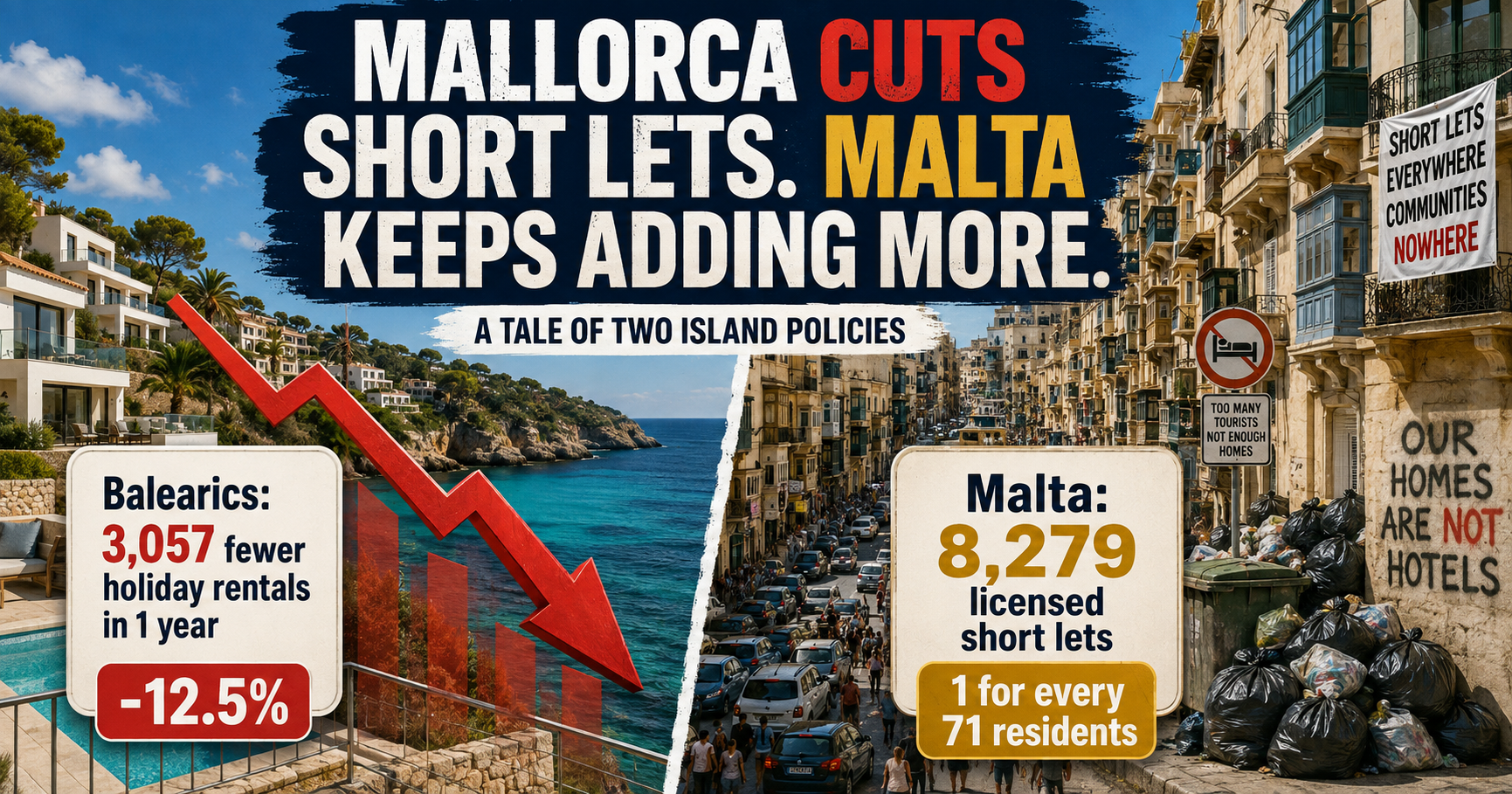
Holiday rental listings across the Balearic Islands have fallen by more than 3,000 properties in just one year. Meanwhile, Malta and Gozo currently have approximately 8,279 licensed short-let properties.
MALTA & GOZO
8,279
licensed short-let properties
ROUGHLY 1 LICENSED SHORT LET
FOR EVERY 71 RESIDENTS
The Balearics: More Than 3,000 Fewer Holiday Rentals
24,361
advertised holiday rentals
May 2025
21,304
advertised holiday rentals
May 2026
−3,057
properties
in one year
Available tourist bed places also dropped from 152,759 to 134,282 — a reduction of 18,477 beds.
The figures reported by the Majorca Daily Bulletin do not prove that every property returned to residential use. Some may have stopped operating or disappeared from the platforms being measured. What they do show clearly is that the number of holiday rentals being advertised has fallen significantly.
Now Look at Malta
BALEARIC ISLANDS
Advertised holiday rentals
2025: 24,361
2026: 21,304
↓ 3,057
MALTA & GOZO
Licensed short lets
8,279
Approximately 1 for every 71 residents
Important: these are not identical datasets. The Balearic figure measures properties advertised on digital platforms, while Malta’s figure comes from the MTA licensing register. The comparison therefore illustrates the scale and direction of the two markets rather than claiming they are statistically identical.
Malta’s Problem Is Not Just Numbers — It’s Density
316 km²
entire Maltese Islands
8,279
licensed short lets
26+
per km² on a crude nationwide calculation
But the pressure is not evenly distributed.
Places such as Sliema, St Julian’s, Gżira, Swieqi, Valletta and St Paul’s Bay experience a far heavier concentration, with residents and visitors sharing the same apartment blocks, streets, pavements, waste infrastructure and public spaces.
And Tourist Numbers Keep Growing
458,223
tourists in June 2026
2.58m
tourist nights in one month
Around 86,000 tourists were staying in Malta on an average night in June — ON TOP OF the resident population.
Does Malta Really Need More Tourist Accommodation?
56,329
collective accommodation bed places
71.3%
net bed occupancy in Q2 2026
8,279
licensed short-let properties on top of this
If Malta already has tens of thousands of hotel beds AND more than 8,000 licensed short lets, how much more tourist accommodation does the country actually need?
New Rules — But Thousands Keep Their Existing Rights
Malta introduced new short-let regulations in 2026, including requirements concerning waste management and having a responsible person available to deal with complaints.
Several stricter requirements do not apply in the same way to thousands of properties licensed before
15 June 2026 because existing establishments retain acquired rights.
Malta tightened the rules — but much of the existing market remains protected.
What About The People Who Actually Live In The Building?
Earlier proposals considered requiring approval from a majority of condominium owners before a new short let could operate in an apartment block. That did not become the final requirement.
Under the current framework, the condominium administrator is notified once the licence has been issued.
NOTIFICATION IS NOT CONSENT.
The people living above, below and beside the property are the ones who may experience the constant guest turnover, noise, waste issues, overcrowding and increased use of communal areas.
Rules Mean Little Without Enforcement
Recent inspections have already uncovered licensing breaches, operational infringements, overcrowding and properties operating without the required authorisation.
With more than 8,000 licensed properties, can the authorities realistically inspect the sector often enough to make those regulations meaningful?
This Is Not About Being Against Tourism
Tourism is essential to Malta’s economy. The issue is not whether tourists should visit Malta. The issue is whether unlimited tourism growth should automatically be treated as success.
Malta needs to answer some uncomfortable questions.
◆ Should saturated localities have a cap on new short-let licences?
◆ Should residents have a meaningful say before another apartment becomes tourist accommodation?
◆ Should repeated noise, waste and overcrowding breaches lead to licence suspension?
◆ Should licences be linked to the carrying capacity of individual localities?
◆ And who decides when Malta finally has enough tourist accommodation?
THE BALEARICS HAVE NOT SOLVED OVERTOURISM.
But their latest figures show something Malta urgently needs to discuss:
GROWTH DOES NOT HAVE TO BE ENDLESS.
The question is no longer whether Malta can squeeze in more tourists.
The question is how much pressure our communities should be expected to absorb before somebody finally says:
ENOUGH.