

Meta description: Green, wet patches are appearing on pavements where water repeatedly runs onto the street. What may look like a minor nuisance can become a serious pedestrian safety issue.
There is more green appearing on our streets. Unfortunately, this is not the kind of greening Malta needs.
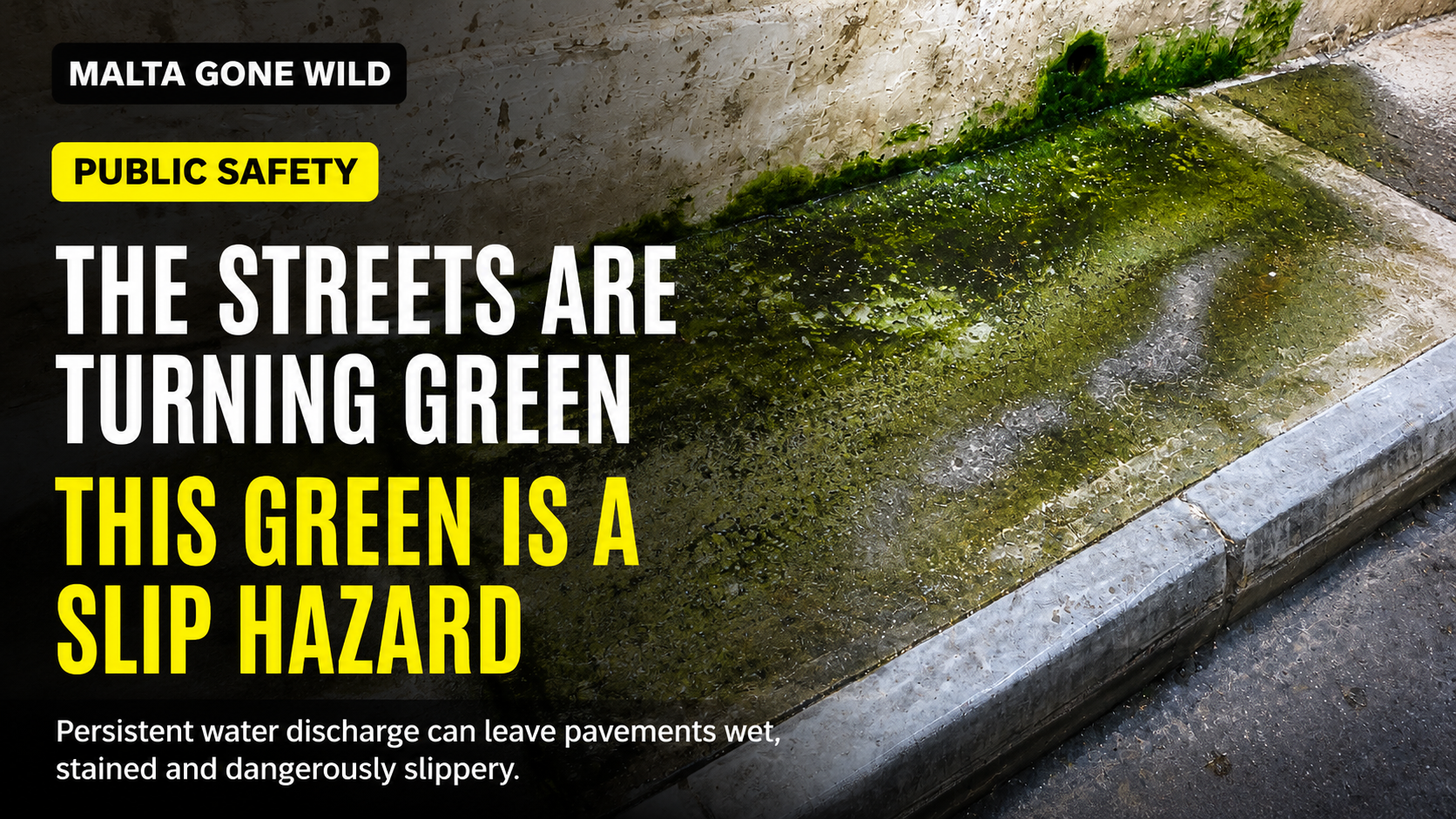
Photos supplied to Malta Gone Wild on 18 August show several sections of pavement where water appears to have been repeatedly running or collecting in the same places.
The result is difficult to miss: blackened concrete, persistent damp patches and, in some areas, clearly visible green growth along walls, kerbs and pavements.
Some of the locations appear consistent with water being discharged from buildings, including possible air-conditioning condensate.
However, MGW cannot determine the exact source of every wet patch from photographs alone. Water could also originate from washing, private drainage or another type of leak.
What can be seen clearly is the consequence.
The pavement is staying wet long enough for staining and green biological growth to develop.
This is not simply ugly
When the same section of pavement remains damp day after day, algae or similar biofilm can establish itself on the surface.
That matters because algae-covered paving can become extremely slippery. A scientific study examining algae colonisation of paved surfaces specifically noted that the presence of algae made pavement slippery and created a potential fall hazard.
So what starts as a small trickle of water can eventually become a genuine pedestrian-safety problem.
And on Malta’s already narrow and uneven pavements, an additional slippery surface is hardly something pedestrians need.
Older residents, people with mobility difficulties, children and anyone using a walking aid or pushing a pram can be particularly exposed when a section of pavement suddenly loses grip.
The air conditioner may be inside. The water ends up outside.
Air-conditioning systems remove moisture from indoor air as part of the cooling process.
That water has to go somewhere. When it is properly collected or directed into suitable drainage, there is little reason for pedestrians ever to notice it.
The problem begins when water is allowed to repeatedly run across a public pavement or collect against a wall. One drip may seem insignificant. Thousands of drips, every day throughout the summer, are another matter.
The photographs sent to MGW show exactly why repeated wetting deserves attention. The concrete becomes darker. Dirt sticks to the damp surface. Green growth begins appearing around the permanently wet areas.
Eventually the pavement can become something pedestrians instinctively try to walk around.
Cleaning it is only half the solution
Scrubbing away the green growth may temporarily improve the pavement. But unless the source of the water is addressed, the same problem is likely to return. The sensible solution is not complicated.
Water should be properly collected or redirected so that the same area of public pavement is not continuously being soaked. Only then does cleaning the affected pavement become a lasting solution rather than a temporary cosmetic fix.
This is one of those small urban-maintenance problems that becomes much bigger simply because it is allowed to continue.
See one? Report it
Malta’s Clean & Upkeep service allows residents to report problems involving infrastructure maintenance and the cleaning of public areas. Reports can include photographs and location details, and cases can be tracked through the service.
Residents can also report persistent pavement hazards to the relevant Local Council. If the water appears to be coming from beneath the road or pavement rather than from a nearby property, it could instead be a Water Services Corporation leak. WSC specifically asks residents to report water leaking in roads or footpaths and provides a dedicated reporting service for these cases.
- Take a photograph.
- Record the exact location.
- If possible, photograph where the water appears to originate.
- And report the problem before somebody discovers just how slippery that green patch has become.
Malta needs greener streets. Just not like this.
We regularly hear about the need for greener towns, greener public spaces and greener communities.
Absolutely. Trees, plants and proper urban landscaping would be very welcome. A coating of green growth caused by pavements being permanently soaked is something else entirely.
It is unsightly. It can damage the quality of the public realm. And most importantly, it can become dangerous. Sometimes improving a neighbourhood does not require another strategy, consultation or multi-million-euro project.
Sometimes somebody simply needs to stop the water running across the pavement. Editorial note: Malta Gone Wild is documenting the condition of public pavements shown in the submitted photographs. The photographs alone do not establish the precise source of the water or responsibility for any individual location.